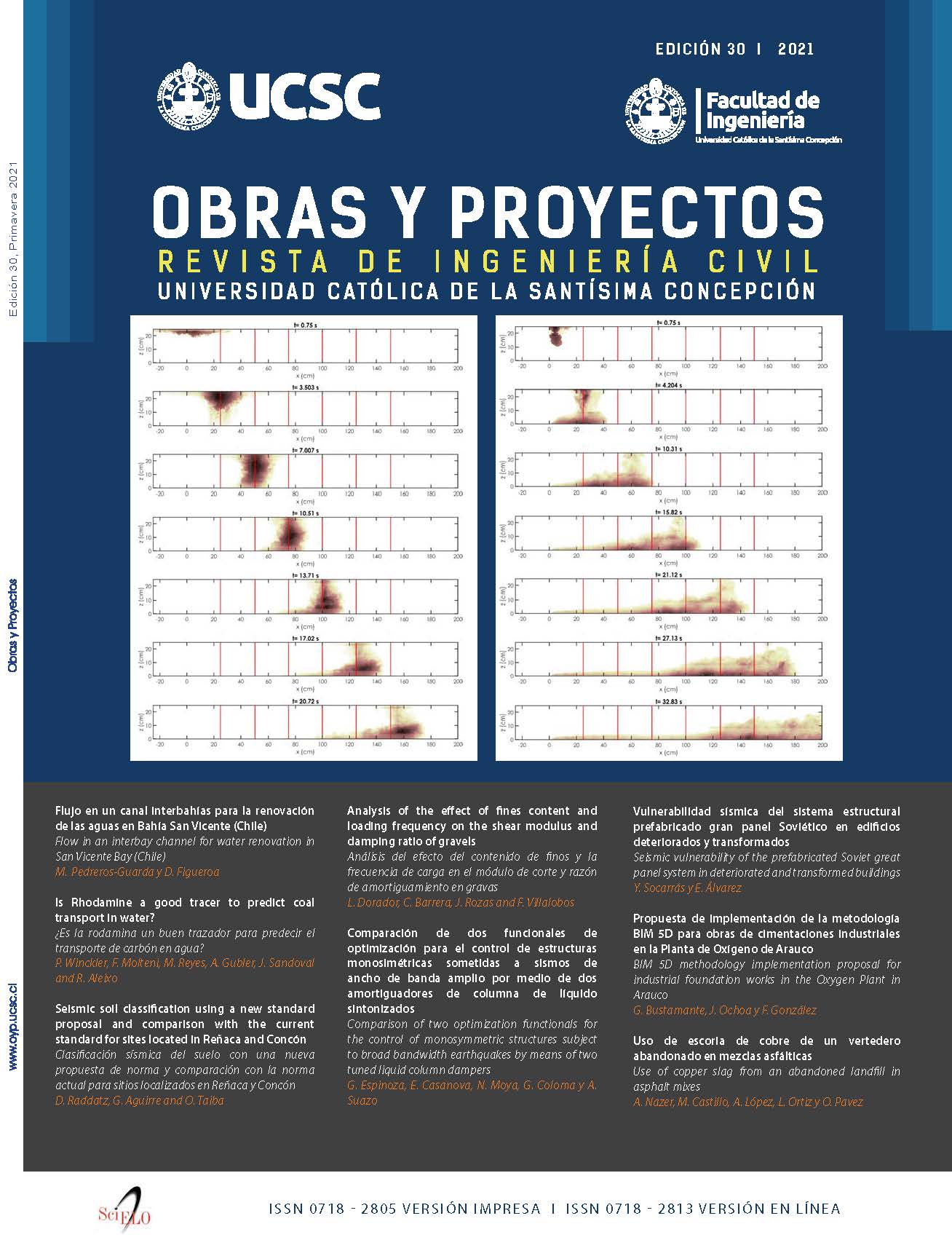
Flujo en un canal interbahías para la renovación de las aguas en Bahía San Vicente (Chile)
DOI:
https://doi.org/10.4067/S0718-28132021000200006Palabras clave:
Canal artificial, Forzante mareal, Bahía contaminada, Chile CentralResumen
La bahía San Vicente, en el litoral de Chile central, es un cuerpo de agua particularmente contaminado. En este trabajo se propone la construcción de un canal que la comunique con la bahía de Concepción, para ayudar a su descontaminación. Usando una versión corregida del modelo de canal de Vennell se calcula el flujo de agua entre ambas bahías, sin y con una compuerta entre ellas, y se muestra que en el segundo caso la combinación de diferencia mareal y los vientos logran en cerca de un mes la renovación de las aguas de la zona más críticamente contaminada de bahía San Vicente.
Referencias
Aguirre-Martínez, G., Rudolph, A., Ahumada, R., Loyola, R. y Medina, V. (2009). Toxicidad no específica en sedimentos portuarios, una aproximación al contenido de contaminantes críticos. Revista de Biología Marina y Oceanografía 44(3), 725-735.
Ahumada, R., Rudolph, A., Madariaga, S. y Carrasco, F. (1989). Descripción de las condiciones oceanográficas de Bahía San Vicente y antecedentes sobre los efectos de la contaminación. Biología Pesquera 18, 37-52.
Ahumada, R. (1992). Patrones de distribución espacial de Cr, Ni, Cu, Zn, Cd y Pb, en sedimentos superficiales de bahía San Vicente, Chile. Revista de Biología Marina, Valparaíso 27(2), 265-281.
Ahumada, R., Rudolph, A. and Martinez, V. (1983). Circulation and fertility of waters in Concepción Bay. Estuarine, Coastal and Shelf Science 16(1), 95-105.
Aránguiz, R., Villagrán, M., Esteban, M. and Shibayama, T. (2014). Tsunami resonance in the Bay of Concepcion, Chile. Proceedings of the 34th Conference on Coastal Engineering, Seoul, South Korea.
Blanchfield, J., Garrett, C., Wild, P. and Rowe, A. (2008). The extractable power from a channel linking a bay to the open ocean. Proceedings of the Institution of Mechanical Engineers, Part A: Journal of Power and Energy 222(3), 289-297.
Chow, V.T. (1994). Hidráulica de canales abiertos. 4ta ed., McGraw-Hill, México.
DIRECTEMAR (2019). Boletín estadístico marítimo. Armada de Chile, Valparaíso, Chile.
Falvey, M. and Garreaud, R. (2007). Wintertime precipitation episodes in central Chile: Associated meteorological conditions and orographic influences. Journal of Hydrometeorology 8(2), 171–193.
Garrett, C. and Cummins, P. (2005). The power potential of tidal currents in channels. Proceedings of the Royal Society A: Mathematical, Physical and Engineering Sciences 461(2060), 2563-2572.
Gholizadeh, M.H., Melesse, A.M. and Reddi, L. (2016). A comprehensive review on water quality parameters estimation using remote sensing techniques. Sensors 16(8), 1298.
Link, O., Brox-Escudero, L.M., González, J., Aguayo, M., Torrejón, F., Montalva, G. and Eguibar-Galán, M.Á. (2019). A paleo-hydro-geomorphological perspective on urban flood risk assessment. Hydrological Processes 33(25), 3169-3183.
Pedreros-Guarda, M. (2020). Estudio físico de un canal Interbahías para la renovación de las aguas en la Bahía San Vicente, Región del Biobío, Chile. Título profesional de Geofísica, Universidad de Concepción, Chile.
Rudolph, A., Ahumada, R. and Pérez, C. (2002). Dissolved Oxygen content as an index of water quality in San Vicente Bay, Chile (36°′ S). Environmental Monitoring and Assessment 78(1), 89-100.
Russell, T.F. (1989). Stability analysis and switching criteria for adaptive implicit methods based on the CFL condition. Symposium on Reservoir Simulation, SPE, Houston, USA, 97-107.
Sobarzo, M.B., Figueroa, D. and Arcos, D.R. (1997). The influence of winds and tides in the formation of circulation layers in a bay, a case study: Concepción Bay, Chile. Estuarine, Coastal and Shelf Science 45(6), 729-736.
Solorza, S., Yee-Romero, C., Jordan-Aramburo, A. and CardeñaSánchez, S. (2010). El término de error en los esquemas de diferencias finitas. Latin-American Journal of Physics Education 4(1), 168-173.
Srain, B. and Rudolph, A. (2010). Acetylcholinesterase activity, antioxidant defenses, and lipid peroxidation in the clam Semele solida: Can this species be used as a bioindicator?. Revista de Biología Marina y Oceanografía 45(2), 227-233.
Trenberth, K.E., Large, W.G. and Olson, J.G. (1989). The effective drag coefficient for evaluating wind stress over the oceans. Journal of Climate 2(12), 1507-1516.
Valenzuela, J. (2003). Caso: Recuperación ambiental integral de la Comuna de Talcahuano, Chile. Asociación Mundial del Agua, Estocolmo, Suecia.
Vallis, G.K. (2006). Atmospheric and oceanic fluid dynamics: fundamentals and large-scale circulation. Cambridge University Press, UK, 107, 702-703.
Vennell, R. (2010). Tuning turbines in a tidal channel. Journal of Fluid Mechanics 663, 253-267.
Vennell, R. (2011). Estimating the power potential of tidal currents and the impact of power extraction on flow speeds. Renewable Energy 36(12), 3558-3565.
Wu, F.C., Shen, H.W. and Chou, Y.J. (1999). Variation of roughness coefficients for unsubmerged and submerged vegetation. Journal of Hydraulic Engineering 125(9), 934-942.
Descargas
Publicado
Número
Sección
Licencia

Esta obra está bajo una licencia internacional Creative Commons Atribución-NoComercial 4.0.