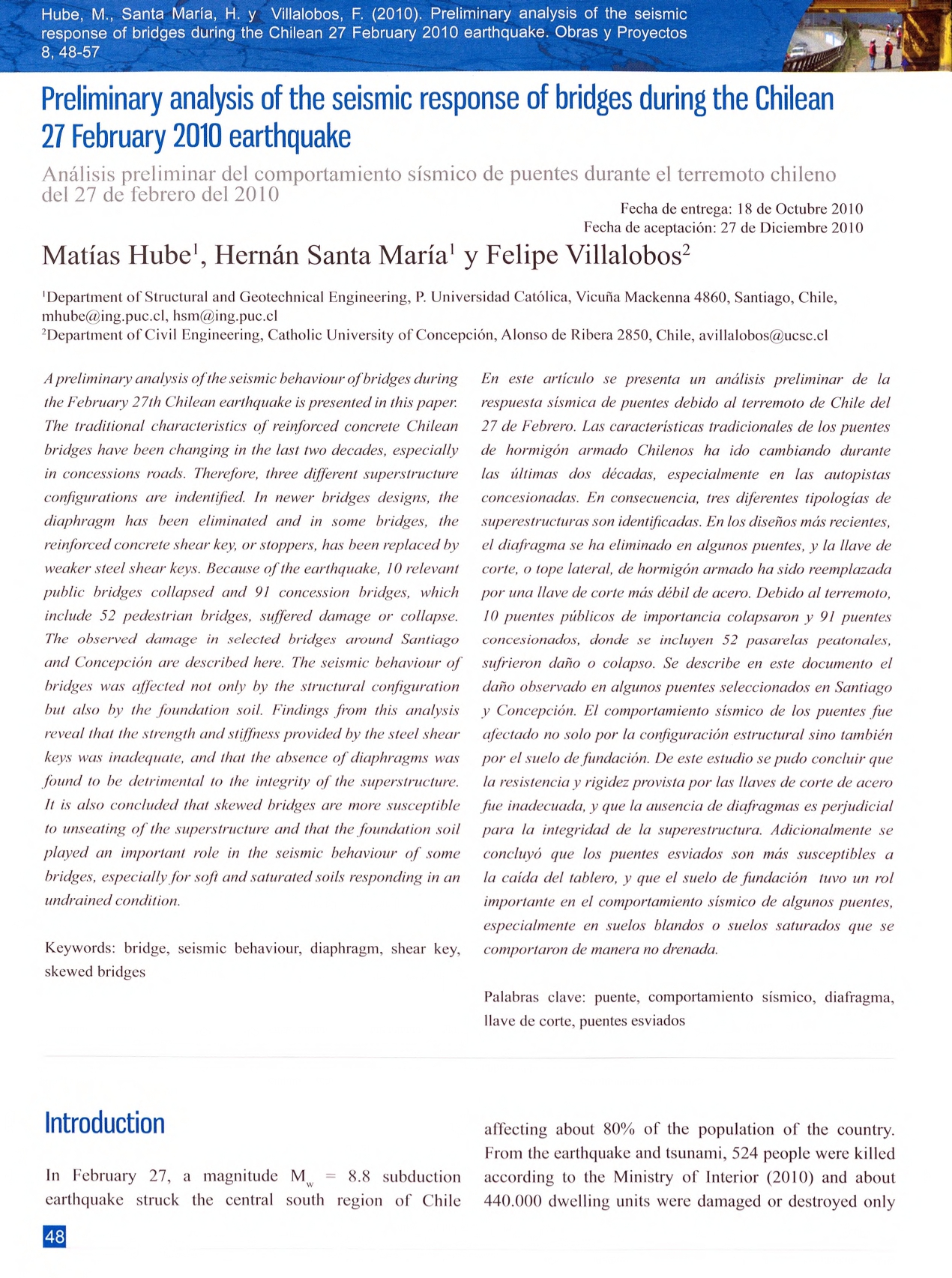
Preliminary analysis of the seismic response of bridges during the Chilean 27 February 2010 earthquake
DOI:
https://doi.org/10.21703/0718-2813.2010.8.3731Keywords:
bridge, seismic behaviour, diaphragm, shear key, skewed bridgesAbstract
A preliminary analysis of the seismic behaviour of bridges during the February 27th Chilean earthquake is presented in this paper. The traditional characteristics of reinforced concrete Chilean bridges have been changing in the last two decades, especially in concessions roads. Therefore, three different superstructure configurations are indentified. In newer bridges designs, the diaphragm has been eliminated and in some bridges, the reinforced concrete shear key, or stoppers, has been replaced by weaker steel shear keys. Because of the earthquake, 10 relevant public bridges collapsed and 91 concession bridges, which include 52 pedestrian bridges, suffered damage or collapse. The observed damage in selected bridges around Santiago and Concepción are described here. The seismic behaviour of bridges was affected not only by the structural configuration but also by the foundation soil. Findings from this analysis reveal that the strength and stiffness provided by the steel shear keys was inadequate, and that the absence of diaphragms was found to be detrimental to the integrity of the superstructure. It is also concluded that skewed bridges are more susceptible to unseating of the superstructure and that the foundation soil played an important role in the seismic behaviour of some bridges, especially for soft and saturated soils responding in an undrained condition.
References
AASHTO (1996, 2002). Standard Specifications for Highway bridges, 16th and 17th editions, American Association of State and Highway Transportation Officials.
AASHTO (2004). LRFD Bridge Design Specifications, 3rd Edition. American Association of State and Highway Transportation Officials.
Caltrans (2006). Seismic design criteria, Version 1.4., California Department of Transportation.
CEPAL (2010). Terremoto de Chile, una primera mirada al 10 de Marzo de 2010, Naciones Unidas, Santiago de Chile.
GEER Association (2010). Section 9 Effects of ground failure on bridges, roads, railroads, and lifeline systems. (http://www.geerassociation.org/)
Ministry of the Interior (2010). Chile, www.interior.gov.cl.
MOP (2002). Manual de Carreteras, Instrucciones y criterios de diseño. Puentes y estructuras afines. Volumen 3, capítulo 3.1000. Dirección de Vialidad, MOP, Chile
MOP (2008). Puentes para Chile 2020, Ministerio de Obras Públicas, Gobierno de Chile.
MOP (2010a). Manual de Carreteras, Instrucciones y criterios de diseño. Puentes y estructuras afines. Volumen 3, capítulo 3.1000. Dirección de Vialidad, MOP, Chile
MOP (2010b). Cuenta Pública 2010, cuenta sectorial, Ministerio de Obras Públicas, Gobierno de Chile. http://www.gobiernodechile.cl/cuenta-publica-2010/ministerio-de-obras-publicas/cuenta-sectorial/.
NCH433 (1996), Diseño sísmico de edificios, NCh433. Of. 1996, Instituto de Normalización, Chile.
Steinbrugge, K.V. and Flores, R. (1963). The Chilean earthquake of May, 1960: a structural engineering viewpoint. Bulletin of the Seismological Society of America 53(2), 225-307 DOI: https://doi.org/10.1785/BSSA0530020225
Watanabe, G. and Kawashima, K. (2004). Effectiveness of cable-restrainer for mitigating rotation of a skewed bridge subjected to strong ground shaking. 13th World Conference on Earthquake Engineering, Vancouver, B.C., Canada
Downloads
Published
Issue
Section
License
Copyright (c) 2010 Universidad Católica de la Santísima Concepción

This work is licensed under a Creative Commons Attribution-NonCommercial 4.0 International License.