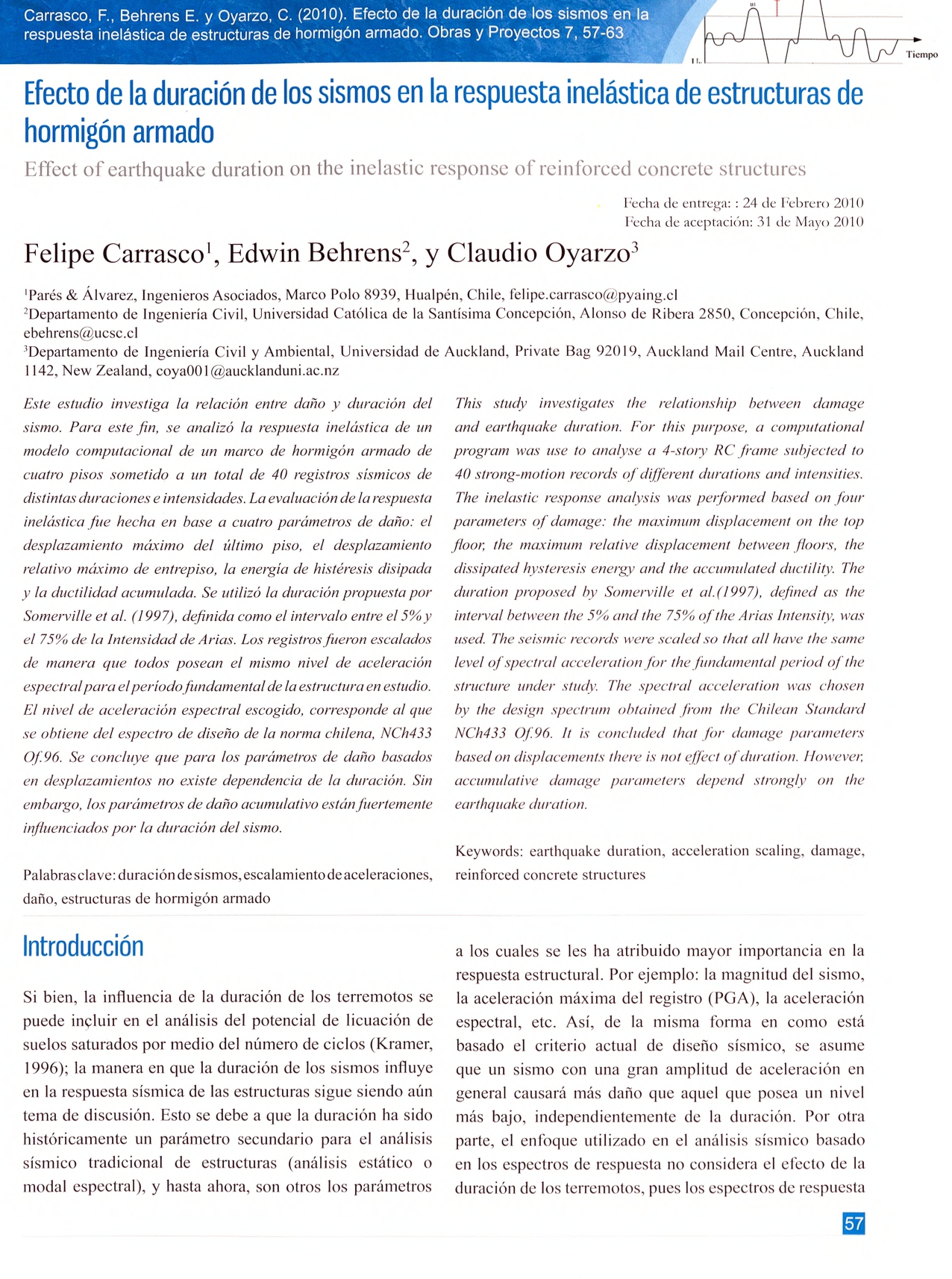
Effect of earthquake duration on the inelastic response of reinforced concrete structures
DOI:
https://doi.org/10.21703/0718-2813.2009.7.3723Keywords:
earthquake duration, acceleration scaling, damage, reinforced concrete structuresAbstract
This study investigates the relationship between damage and earthquake duration. For this purpose, a computational program was use to analyse a 4-story RC frame subjected to 40 strong-motion records of different durations and intensities. The inelastic response analysis was performed based on four parameters of damage: the maximum displacement on the top floor, the maximum relative displacement between floors, the dissipated hysteresis energy and the accumulated ductility. The duration proposed by Somerville et al.(1997), defined as the interval between the 5% and the 75% of the Arias Intensity, was used. The seismic records were scaled so that all have the same level of spectral acceleration for the fundamental period of the structure under study. The spectral acceleration was chosen by the design spectrum obtained from the Chilean Standard NCh433 Of.96. It is concluded that for damage parameters based on displacements there is not effect of duration. However, accumulative damage parameters depend strongly on the earthquake duration.
References
Arias, A. ( 1970). A Measure of Earthquake Intensity. MIT Press, Cambridge, MA, USA, 438-483
Carrasco, F.A. (2009). Efecto de la duración de los terremotos en la respuesta inelástica de estructuras. Memoria para optar al título de Ingeniero Civil. Universidad Católica de la Santísima Concepción
CISMID Centro Peruano Japonés de Investigaciones Sísmicas y Mitigación de Desastres, http://www.cismid-uni.org/
COSMOS Consortium of Organizations for Strong Motion Observation Systems, The Cosmos Website, http://db.cosmos-eq.org
Filippou, F.C., Popov, E.P. and Bertero, V.V. (1983). Modelling RC Joints under Cyclic Excitations. Journal of Structural Engineering 109, No 11, 2666-2684 DOI: https://doi.org/10.1061/(ASCE)0733-9445(1983)109:11(2666)
Fragiadakis, M. (2001). Nonlinear material modeling of reinforcement steel bars under transient loading. MSc Dissertation, Department to Civil and Environmental Engineering, Imperial College, London, UK
Husid, L.R. (1969). Características de terremotos. Análisis general. Revista del IDIEM 8, Santiago de Chile, 21-42
ICH (2002). Código de Diseño de Hormigón Armado, basado en el ACI 318. Instituto Chileno del Cemento y el Hormigón, Santiago, Chile
Kramer, S. (1996). Geotechnical Earthquake Engineering. Prentice Hall
LSMF-PUC. Laboratorio de Sismología de Movimiento Fuerte. Departamento de Ingeniería Estructural y Geotécnica, Pontificia Universidad Católica de Santiago, http://www2.ing.puc.cl/~wwwice/sismologia
Mander, J.B., Priestley, M.J.N. and Park, R. (1989). Theoretical Stress-strain Model for Confined Concrete. Journal of Structural Engineering 114, No 8, 1804-1826 DOI: https://doi.org/10.1061/(ASCE)0733-9445(1988)114:8(1804)
Martínez-Rueda, J. and Elnashai, A. (1997). Confined Concrete Model under Cyclic Load. Materials and Structures 30, No 8, 139-147 DOI: https://doi.org/10.1007/BF02486385
Menegotto, M. and Pinto, P.E. (1973). Method of Analysis for Cyclically Loaded RC Plane Frames Including Changes in Geometry and Non-elastic Behavior of Elements under Combined Normal Force and Bending. Symposium on the Resistance and Ultimate Deformability of Structures Acted on by Well Defined Repeated Loads, International Association for Bridge and Structural Engineering, Zurich, Switzerland, 15-22
INN-Chile (1996). Diseño sísmico de edificios, NCh433Of96
Oyarzo, C. (2009). Métodos de selección y escalamiento de registros sísmicos para análisis de la respuesta en el tiempo. Obras y Proyectos 5, 18-25 DOI: https://doi.org/10.21703/0718-2813.2009.5.3679
PEER NGA, Pacific Earthquake Engineering Research Center, PEER NGA Database, http://peer.berkeley.edu/nga/index.html
Seismosoft (2007). SeismoStruct – A computer program for static and dynamic nonlinear analysis of framed structures. Available from URL: http://www.seismosoft.com
Somerville, P.G., Smith, N.F., Graves, R.W. and Abrahamson, N.A. (1997). Modification of empirical strong ground motion attenuation relations to include the amplitude and duration effects of rupture directivity. Seismological Research Letters 68, No 1,199-222 DOI: https://doi.org/10.1785/gssrl.68.1.199
Downloads
Published
Issue
Section
License
Copyright (c) 2009 Universidad Católica de la Santísima Concepción

This work is licensed under a Creative Commons Attribution-NonCommercial 4.0 International License.