Geotechnical explorations for offshore wind turbine foundations
DOI:
https://doi.org/10.21703/0718-2813.2010.7.3711Keywords:
offshore wind turbines, North Sea, geotechnical explorations, boreholes, CPT testingAbstract
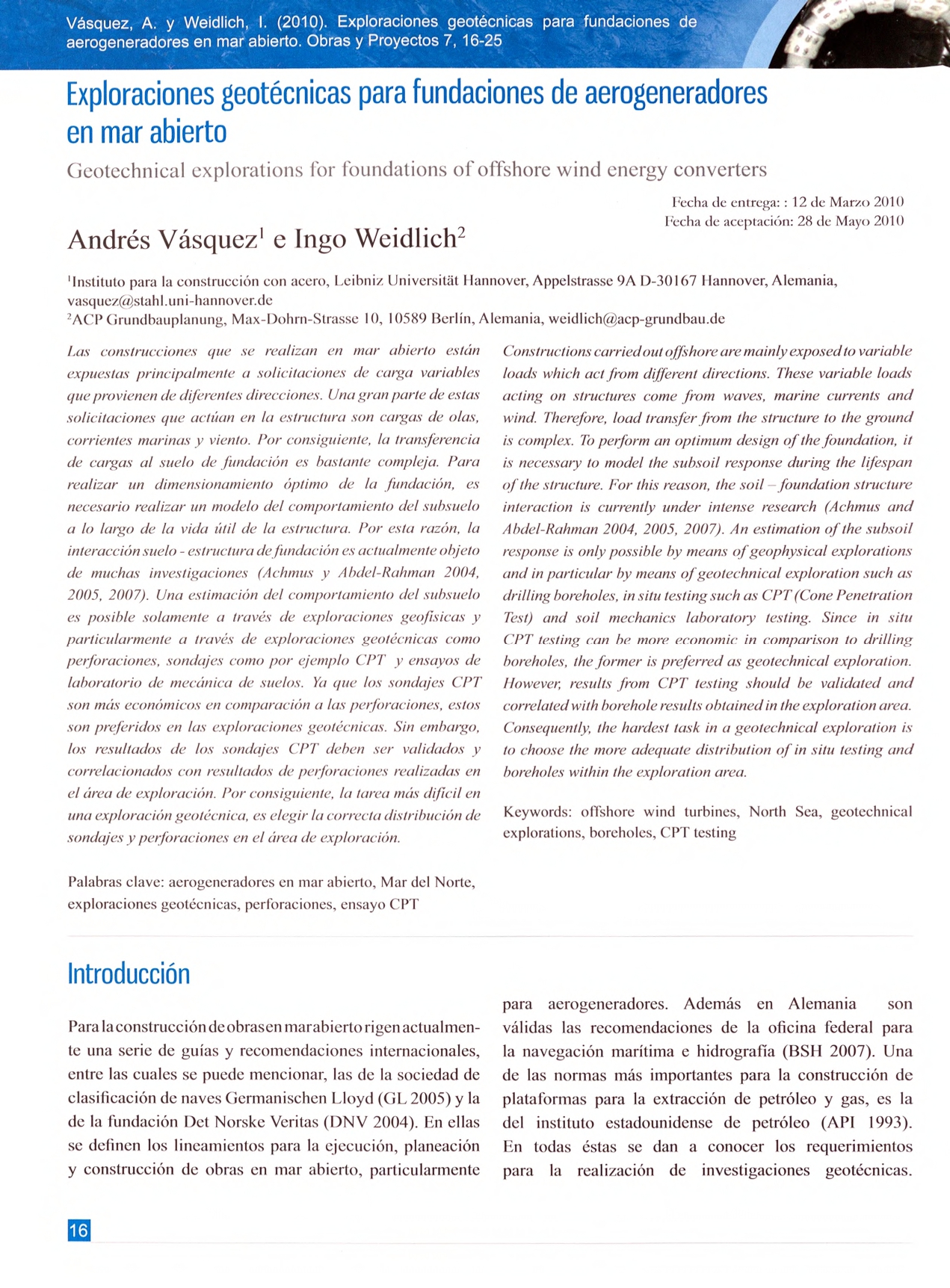
Constructions carried out offshore are mainly exposed to variable loads acting from different directions. A large part of these loads acting on the structure are wave, marine current, and wind loads. Consequently, the transfer of loads to the foundation soil is quite complex. To perform an optimum design of the foundation, it is necessary to model the subsoil behavior throughout the structure's lifespan. For this reason, the soil-foundation structure interaction is currently the subject of much research (Achmus and Abdel-Rahman 2004, 2005, 2007). An estimation of the subsoil behavior is only possible through geophysical explorations and particularly through geotechnical explorations such as boreholes, soundings like CPT, and soil mechanics laboratory tests. Since CPT soundings are more economical compared to boreholes, they are preferred in geotechnical explorations. However, the results of CPT soundings must be validated and correlated with results from boreholes carried out in the exploration area. Therefore, the most difficult task in a geotechnical exploration is choosing the correct distribution of soundings and boreholes in the exploration area.
References
Achmus. M. und Abdel-Rahman, K. (2004). Numerische Untersuchung zum Tragverhalten horizontal helasteter Monopile-Gründungen für Offshore-Windenergieanlagen. 19. Christian Veder Kolloquium, Graz, Österreich.
Achmus, M. und Abdel-Rahman, K. (2005). Numerische Untersuchung zum Tragverhalten von Bucketgründungen für Offshore-Windenergie-Anlagen. Abaqus Benutzerkonferenz, Nürnberg.
Achmus. M. und Abdel-Rahman, K. (2007). Numerical Modelling of Vertical Piles under Inclined Compression Loading. 12th International Colloquium on Structural and Geotechnical Engineering, Alexandria, Egypt.
Alpha Ventus (2010) http://www.alpha-ventus de.
API American Petroleum Institute (1993). Recommended Practice for Planning, Designing and Constructing Fixed Offshore Platforms Working Stress Design. API RP2A WSD, 20th Edition, Dallas.
BSH Bundesamt für Seeschifffahrt und Hydrographie (2010). http://www.bsh.de.
BSH Bundesamt für Seeschifffahrt und Hydrographie (2007). Standard Konstruktive Ausführung von Offshore-Windenergieanlagen, Hamburg und Rostock.
BMU Bundesministerium für Umwelt, Naturschutz und Reaktorsicherheit (2009). Erneubare Energie Deutschlands erste Offshore-Windräder am Netz www.erneuerbare-energien.de/inhalt/44738/4591. Nr.263/09, Berlin, 13.08.2009.
dena Deutsche Energie-Agentur GmbH (2010). Interaktive Nord- und Ostseekarte zum Status der Projekte, Energiesysteme und Energiedienstleistungen, Berlin, http://www.offshore-wind.de, http://www.dena.de.
DNV Det Norske Veritas (2004). Offshore Standard: DNV-OS-J101. Design of Offshore Wind Turbine Structures. Horvik, Norway.
DIN Deutsches Institut für Normung (2002). DIN 4094 Felduntersuchungen, Europäisches Komitee für Normung. Beuth Verlag Berlin.
DIN Deutsches Institut für Normung (1990). DIN 4021 Aufschluß durch Schürfe und Bohrungen sowie Entnahme von Proben. Beuth Verlag Berlin.
GL Germanischer Lloyd (2005) Rules and Guidelines, IV Industrial Services, Part 2: Guideline for Certification of Offshore Wind Turbines, Germanischer Lloyd Industrial Services Hamburg.
GL Germanischer Lloyd Industrial Services GmbH (2010). Fmo Forschungsplattformen in Nord und Ostsee http://www.fino-offshore.de.
Jamiolkowski, M., Ghionna, V. N.. Lancellotta, R., and Pasqualini E. (1988). New correlations of penetration tests for design practice. Penetration Testing 1988, ISOPT-1. DeRuiter (ed.). Balkema, Rotterdam.
Lesny. K. (2008). Gründung von Offshore-Windenergieanlagen - Werkzeuge für Plannung und Bemessung, VGE Verlag GmbH, Universität Duisburg, Essen.
Lesny. K. (2008b). Foundations for offshore wind energy converters Recommendations for concept and design. Bautechnik 85, Heft 8, 503-511 (en alemán). DOI: https://doi.org/10.1002/bate.200810037
Lunne, T., Robertson, P.K. and Powell, J.J.M. (1997). Cone Penetration Testing in Geotechnical Practice. Spon Press.
RAVE Research at Alpha Ventus (2010) http://rave.iset.uni-kassel.de.
Schaumann, P., Böker, C., Rutkowski, T. und Wilke, F. (2007). Tragstrukturen für Windenergieanlagen, in: Stahlbau-Kalender. Verlag Ernst&Sohn. DOI: https://doi.org/10.1002/9783433600733.ch8
Schaumann P.. Wilke F. und Lochte-Holtgreven, S. (2008). Grout-Verbindungen von Monopile-Gründungsstrukturen- Trag- und Ermüdungsverhalten. Stahlbau, 647-658, Ernst & Sohn. DOI: https://doi.org/10.1002/stab.200810078
Sindowiski, K.-H. (1970). Das Quartar im Untergrund der Deutschen Bucht (Nordsee). Eiszeitalter und Gegenwart: Jahrbuch der Deutschen Quartärvereinigung, Band 21, 33-46. DOI: https://doi.org/10.3285/eg.21.1.03
Villalobos, F.A. (2009), Foundations for offshore wind turbines. Revista Ingeniería de Construcción 24 (1), 33-48.
Downloads
Published
Issue
Section
License
Copyright (c) 2010 Universidad Católica de la Santísima Concepción

This work is licensed under a Creative Commons Attribution-NonCommercial 4.0 International License.