Damage assessment of low slenderness reinforced concrete walls using the Park & Ang damage index
DOI:
https://doi.org/10.21703/0718-2813.2006.1.3708Abstract
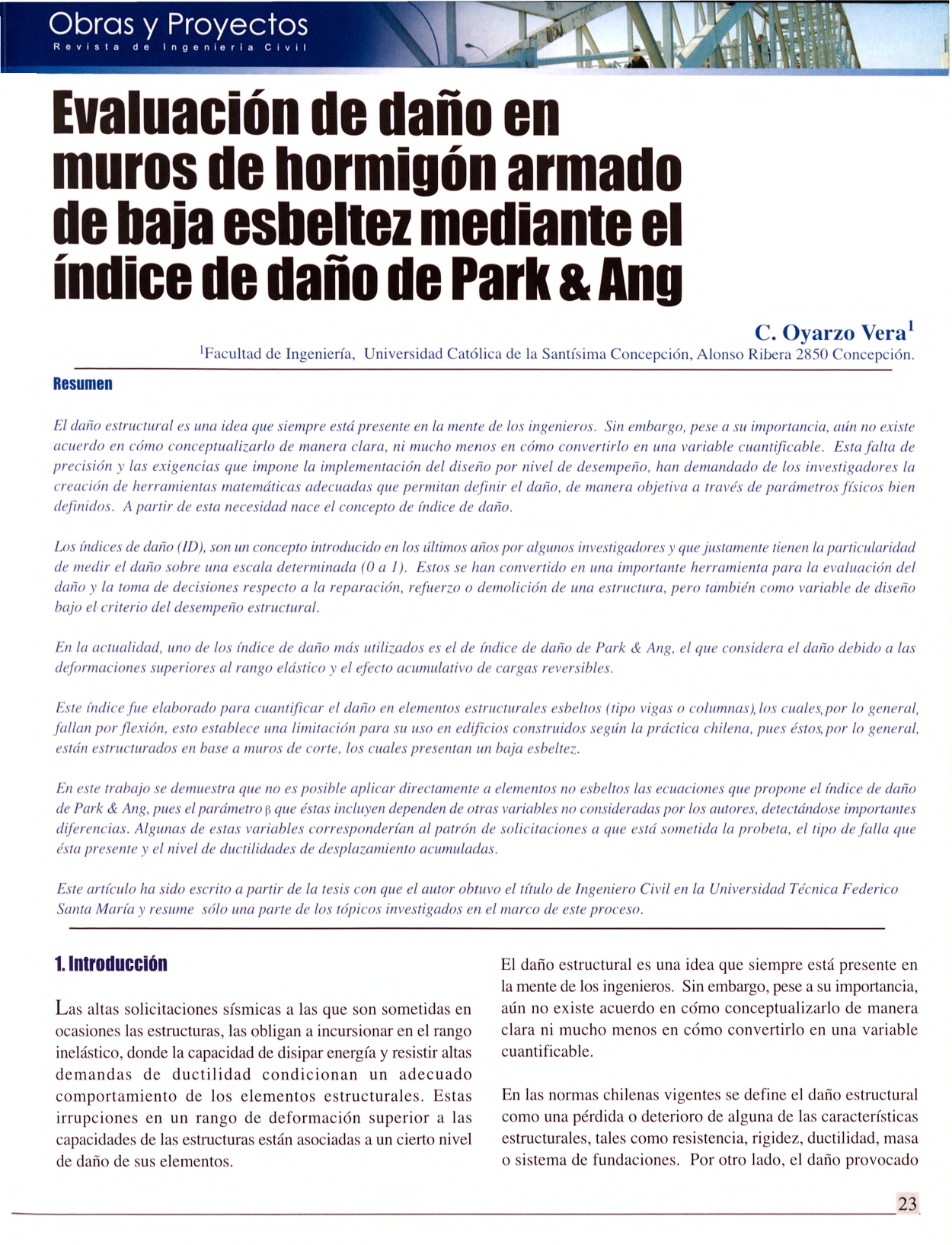
Structural damage is an idea that is always present in the minds of engineers. However, despite its importance, there is still no agreement on how to clearly conceptualize it, much less on how to convert it into a quantifiable variable. This lack of precision and the requirements imposed by the implementation of performance-based design have demanded that researchers create adequate mathematical tools that allow damage to be defined in an objective manner through well-defined physical parameters. From this need, the concept of the damage index was born. Damage indices (DI) are a concept introduced in recent years by some researchers that specifically have the characteristic of measuring damage on a determined scale (0 to 1). These have become an important tool for damage assessment and decision-making regarding the repair, reinforcement, or demolition of a structure, but also as a design variable under the criterion of structural performance. Currently, one of the most widely used damage indices is the Park & Ang damage index, which considers damage due to deformations exceeding the elastic range and the cumulative effect of reversible loads. This index was developed to quantify damage in slender structural elements (such as beams or columns), which generally fail due to bending; this establishes a limitation for its use in buildings constructed according to Chilean practice, as these are generally structured based on shear walls, which present low slenderness. In this work, it is demonstrated that it is not possible to directly apply the equations proposed by the Park & Ang damage index to non-slender elements, because the β parameter they include depends on other variables not considered by the authors, with significant differences being detected.
References
[1] INN-Chile. Norma Chilena Oficial “Diseño sísmico de Edificios”, NCh 433 Of.96
[2] Teran-Gilmore, Amador. “Energy Concept and Damage Indices”, Proceeding of Symposium in Honor of Vitelmo Bertero, Berkeley, California Jan. 31-Feb. 1, 1997.
[3] Park, Young-Ji; Ang, Alfredo. “Mechanistic Seismic Damage Model For Reinforced Concrete”, Journal of Structural Engineering, Vol. 111, N° 4, pp. 722-739, 1985. DOI: https://doi.org/10.1061/(ASCE)0733-9445(1985)111:4(722)
[4] Oyarzo V., Claudio. “Evaluación Del Daño En Muros De Hormigón Armado Sometidos A Altas Demandas De Ductilidad”. Memoria para optar al título de Ingeniero Civil. Universidad Técnica Federico Santa María, 2003.
[5] Williams, Martín; Sexsmith, Robert. “Seismic Damage Indices for Concrete Structures: A State-of-the-Art Review”, Earthquake Spectra, Vol. 11, N° 2, pp. 319-249, 1995. DOI: https://doi.org/10.1193/1.1585817
[6] Leiva, Gilberto; Bonelli, Patricio; Méndez, Javier; Sanz, Cristián; Delgado, Miguel. “Resistencia al Corte de Muros de Hormigón Armado sometido a Altas Demandas de Ductilidad”, Informe Final Proyecto Fondecyt N° 1950391. Diciembre, 1999.
Downloads
Published
Issue
Section
License
Copyright (c) 2006 Universidad Católica de la Santísima Concepción

This work is licensed under a Creative Commons Attribution-NonCommercial 4.0 International License.