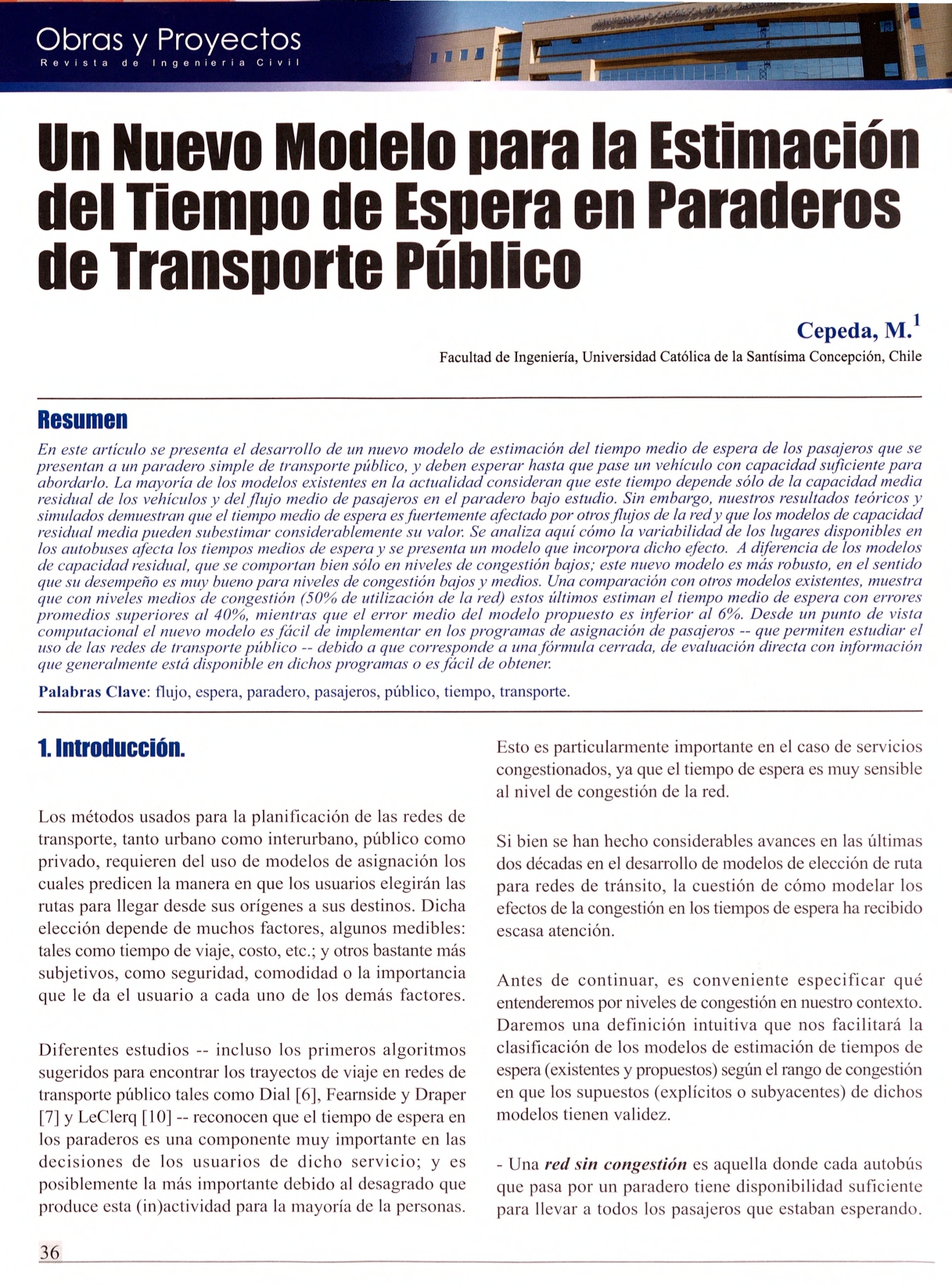
A New Model for the Estimation of Waiting Time at Public Transport Stops
DOI:
https://doi.org/10.21703/0718-2813.2006.2.3701Keywords:
flow, wait, whereabouts, passengers, public, time, transportationAbstract
This article presents the development of a new model for estimating the average waiting time for passengers who arrive at a single public transport stop and must wait until a vehicle with sufficient capacity to board passes by. Most currently existing models consider that this time depends only on the average residual capacity of the vehicles and the average passenger flow at the stop under study. However, our theoretical and simulated results demonstrate that average waiting time is strongly affected by other flows in the network and that average residual capacity models can considerably underestimate its value. This analysis examines how the variability of available seats on buses affects average waiting times and presents a model that incorporates this effect. Unlike residual capacity models, which perform well only at low congestion levels, this new model is more robust, in the sense that its performance is very good for low and medium congestion levels. A comparison with other existing models shows that at medium congestion levels (50% network utilization), the latter estimate the average waiting time with average errors exceeding 40%, while the average error of the proposed model is less than 6%. From a computational point of view, the new model is easy to implement in passenger assignment programs — which allow for the study of public transport network usage — because it corresponds to a closed formula for direct evaluation with information that is generally available in such programs or easy to obtain.
References
[1] P. Beltrán, Congestión y Equilibrio en Redes de Transporte Público, Tésis de Magister en Ciencias de la Ingeniería Mención Transportes, Dpto. Ing. Civil, Universidad de Chile, 2002.
[2] Bouzaïene-Ayari B., Gendreau M., and Nguyen S., “Modeling bus stops in transit networks: a survey and new formulations", Transportation Science 35(3), 304-321, (2001). DOI: https://doi.org/10.1287/trsc.35.3.304.10148
[3] Cepeda M., Modèle d'équilibre dans les réseaux de transport en commun: le cas des capacités explicites des services, Ph.D. Thesis, Département d'Informatique et Récherche Opérationnelle, Publication 2002-43, CRT, U. de Montréal (2002).
[4] Cepeda M., Cominetti R., and Florian M., “A frequency-based assignment model for congested transit networks with strict capacity constraints: characterization and computation of equilibria", Transportation Research Part B 40, 437-459, (2006). DOI: https://doi.org/10.1016/j.trb.2005.05.006
[5] Cominetti R. and Correa J., “Common-lines and passenger assignment in congested transit networks", Transportation Science 35(3), 250--267, (2001). DOI: https://doi.org/10.1287/trsc.35.3.250.10154
[6] Dial R.B., “Transit pathfinder algorithms", Highway Research Record 205, 67--85, (1967).
[7] Fearnside K. and Draper D.P., “Public transport assignment -- a new approach", Traffic Engineering and Control, 298--299, (1971).
[8] Gendreau M., Etude approfondie d'un modèle d'équilibre pour l'affectation de passagers dans les réseaux de transports en commun, Ph.D. Thesis, Département d'Informatique et Récherche Opérationnelle, Publication 384, CRT, U. de Montréal (1984).
[9] Holroyd E. and Scraggs D., “Waiting Times for Buses in Central London", Traffic Engineering and Control {bf 8}, 158-160 (1966).
[10] Le Clercq F., “A public transport assignment model", Traffic Engineering and Control, 91--96, (1972).
[11] Kadosch M., “Temps d'attente dans le transport urban en commun", R.A.I.R.O. Recherche Opérationnelle {bf 10}, 37-54, (1976). DOI: https://doi.org/10.1051/ro/197610V100371
Downloads
Published
Issue
Section
License
Copyright (c) 2006 Universidad Católica de la Santísima Concepción

This work is licensed under a Creative Commons Attribution-NonCommercial 4.0 International License.