Seismic Behavior of Cable-Stayed Bridges: Past, Present and Future
DOI:
https://doi.org/10.21703/0718-2813.2008.3.3692Keywords:
base isolation, cables, active control, bridge, cable-stayed bridge, earthquakeAbstract
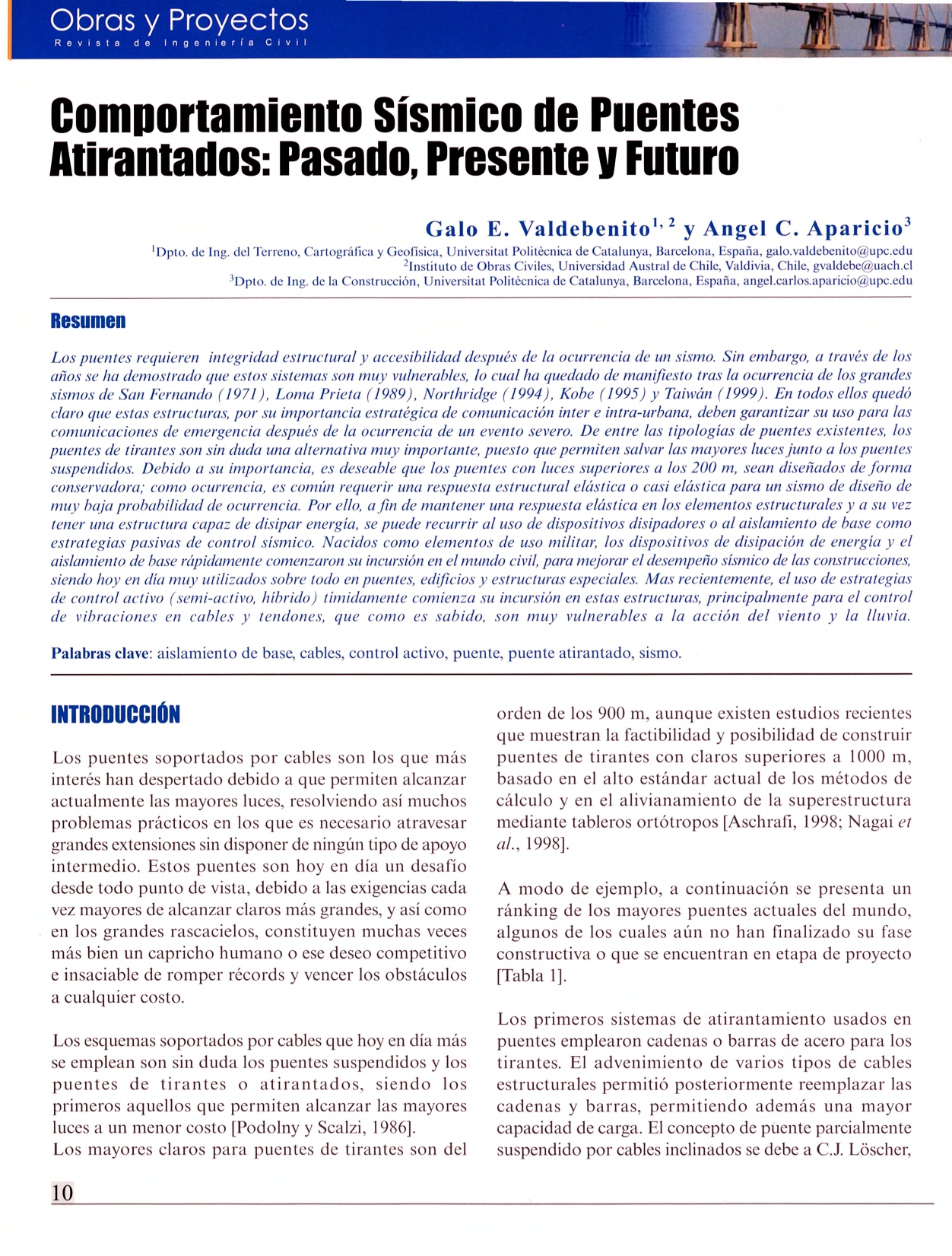
Bridges require structural integrity and accessibility after an earthquake. However, over the years, these systems have proven to be highly vulnerable, as evidenced by the major earthquakes of San Fernando (1971), Loma Prieta (1989), Northridge (1994), Kobe (1995), and Taiwan (1999). In all of these events, it became clear that these structures, due to their strategic importance for inter- and intra-urban communication, must guarantee their usability for emergency communications after a severe event. Among the existing bridge typologies, cable-stayed bridges are undoubtedly a very important alternative, as they allow for the longest spans, along with suspension bridges. Due to their importance, it is desirable that bridges with spans exceeding 200 m be designed conservatively. As a general rule, it is common to require an elastic or near-elastic structural response for a design earthquake with a very low probability of occurrence. Therefore, in order to maintain an elastic response in structural elements and, at the same time, have a structure capable of dissipating energy, energy dissipation devices or base isolation can be used as passive seismic control strategies. Originally developed for military use, energy dissipation devices and base isolation quickly began to be adopted in the civilian sector to improve the seismic performance of buildings, and are now widely used, especially in bridges, buildings, and special structures. More recently, the use of active (semi-active, hybrid) control strategies is tentatively beginning to be implemented in these structures, primarily for vibration control in cables and tendons, which, as is well known, are very vulnerable to the effects of wind and rain.
References
Abdel -Ghaffar, A.M. (1991), Cable-Stayed Bridges under Seismic Action. Proceedings of the Seminar Cable – Stayed Bridges: Recent Development and their Future, Yokohama, Japan.
Ali, H-E and Abdel -Ghaffar, A.M. (1991). Seismic Energy Dissipation for Cable-Stayed Bridges using Passive Devices", Earthquake Engineering and Structural Dynamics, Vol. 23, pp 877 – 893
Álvarez, J. (2004). Respuesta Sísmica de Puentes Arco Empleando Amortiguamiento Viscoso Suplementario. Tesis Doctoral, Departamento de Ingeniería del Terreno, Cartográfica y Geofísica, ETSECCPB, Universidad Politécnica de Catalunya, Barcelona, España
Aschrafi, M. (1998). Comparative Investigations of Suspension Bridges and Cable-Stayed Bridges for Spans Exceeding 1000 m. Proceedings of the IABSE Symposium Japan 1998 Long – Span and High Rise Structures, Kobe, Japan, pp 447 – 452
Chen, Z.Q., Wang, X.Y., Ko, J.M. and Ni, Y.Q., Spencer, B.F., Yang, G. (2003), “MR Damping System on Dongting Lake Cable-Stayed Bridge”, Proceedings of the Conference: Smart Structures and Materials 2003: Smart Systems and Non-destructive Evaluation for Civil Infrastructures, San Diego, USA
Ettouney, M., Hapij, A. and Gajer, R. (2001), “Frequency – Domain Analysis of Long – Span Bridges Subjected to Non-uniform Seismic Motions”, Journal of Bridge Engineering, Vol. 6, No. 6, pp 577 – 586
Infanti, S., Papanikolas, P., Benzoni, G. and Castellano, M.G. (2004), “Rion – Antirion Bridge: Design and Full – Scale Testing of the Seismic Protection Devices”, Proceedings of the 13th World Conference on Earthquake Engineering, Vancouver, Canada, Paper No. 2174.
Lecinq, B., Messein, J.P. and Boutillon, L. (2003), “The Rion-Antirion Bridge Stay Cables: A Seismic Approach”, Proceedings of the FIB Symposium: Concrete Structures in Seismic Regions, Athens, Greece.
Morgenthal, G. (1999), “Cable-Stayed Bridges – Earthquake Response and Passive Control”, Msc Dissertation, Civil Engineering Department, Imperial College of Science, Technology and Medicine, London, UK.
Nagai, M., Xie, X., Yamaguchi, H. and Fujino, Y. (1998), “Economical Comparison Between Cable-Stayed and Suspension Systems with a Span Exceeding 1000 meters”, Journal of Constructional Steel Research, Vol. 46, Nos. 1 – 3, pp 59
Podolny, W. and Scalzi, J.B. (1986), “Construction and Design of Cable – Stayed Bridges”, 2ª edition, John Wiley & Sons, Inc, New York
Ren, W.X. and Obata, M. (1999), “Elastic-Plastic Seismic Behaviour of Long-Span Cable-Stayed Bridges”, Journal of Bridge Engineering, Vol.4, No.3, pp 194 – 203
Schemmann, A.G. and Smith, H.A. (1996), “Vibration Control of Cable-Stayed Bridges: Analytical Development”, Proceedings of the 11th Conference on Engineering Mechanics, Fort Lauderdale, USA, pp 898 – 901
Schemmann, A.G. and Smith, H.A. (1998), “Vibration Control of Cable-Stayed Bridges - Part 1 and 2”, Earthquake Eng. and Str. Dynamics, Vol. 27, pp 811 – 843
Sowluk, K. and Dumanoglu, A.A. (2004), “Spatial Variability Effects of Ground Motions on Cable – Stayed Bridges”, Soil Dynamics and Earthquake Engineering, Vol. 24, No. 3, pp 241 – 250
Valdebenito, G. y Aparicio, A. (2005), “Comportamiento Sísmico de Puentes Atirantados y Disipación de Energía Adicional: Un Estado del Conocimiento”, Monografía CIMNE IS – 54, Centro Internacional de Métodos Numéricos en Ingeniería, Barcelona, España
Valdebenito, G., Aparicio, A. (2007), “Dynamic Characterization of Cable-Stayed Bridges: A Comparative Analysis”, Proceedings of the 5th International Conference on Seismology and Earthquake Engineering, Tehran, Iran
Virlogeux, M. (1999), “Recent Evolution of Cable-Stayed Bridges”, Engineering Structures, Vol. 21, No. 8, pp 737 – 755.
Downloads
Published
Issue
Section
License
Copyright (c) 2008 Universidad Católica de la Santísima Concepción

This work is licensed under a Creative Commons Attribution-NonCommercial 4.0 International License.