Nonlinear stress-strain model for the gravel of Santiago
DOI:
https://doi.org/10.21703/0718-2813.2009.6.3685Keywords:
Santiago gravel, field trials, loading plate, direct shear, unconfined compression and triaxial, finite-element methodAbstract
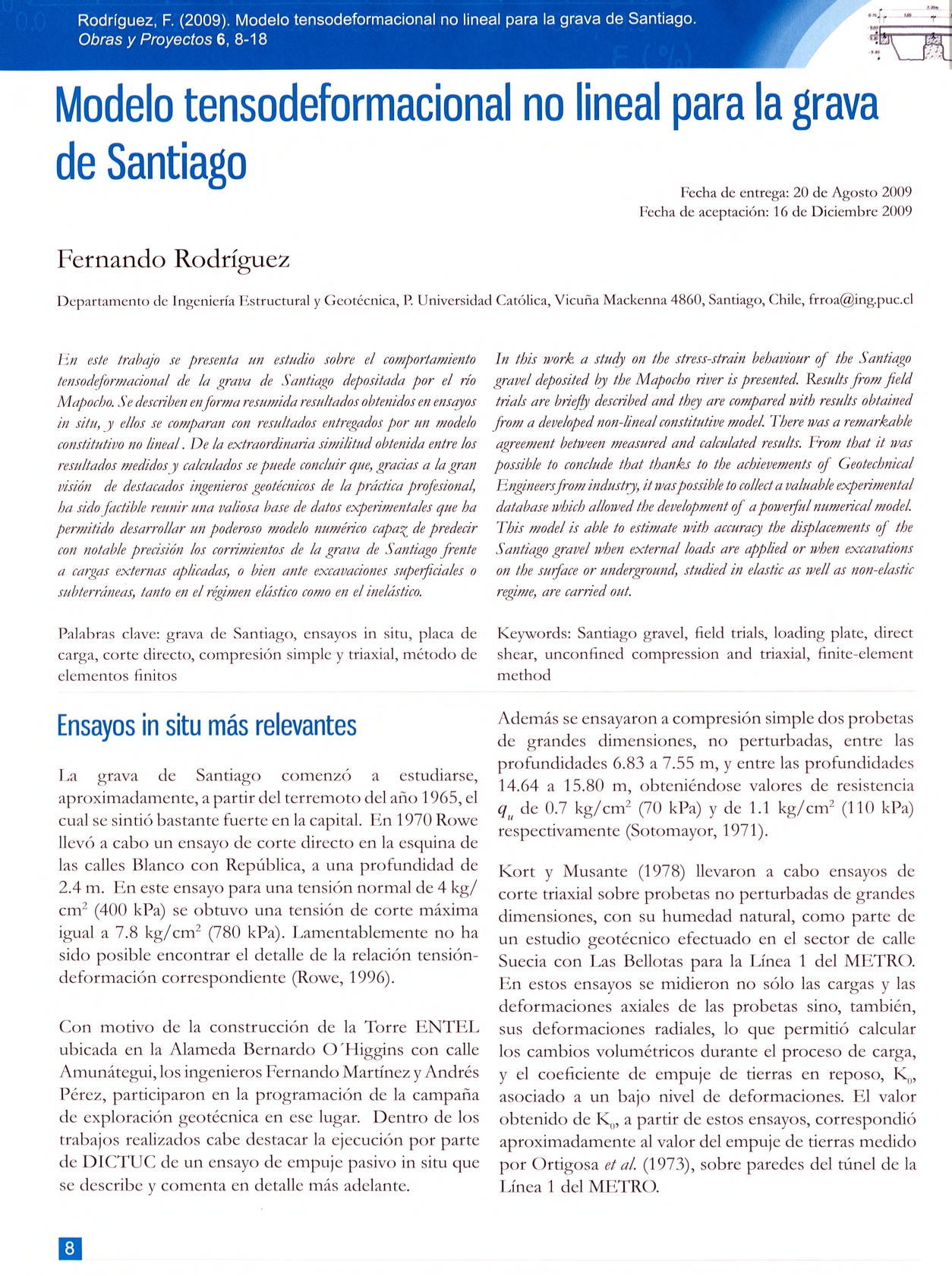
In this work a study on the stress-strain behaviour of the Santiago gravel deposited by the Mapocho river is presented. Results from field Irials are briefly described and they are compared with results obtained from a developed non-lineal constitutive model. There was a remarkable agreement between measured and calculated results. From that it was possible to conclude that thanks to the achievements of Geotechnical Engineers from industry, it was possible to collecta valuable experimental database which allowed the development of a powerful numerical model. This model is able to estimate with accuracy the displacements of the Santiago gravel when external loads are applied or when excavations on the surface or underground, studied in elastic as well as non-elastic regime, are carried out.
References
Campos, J. (1981). Análisis de excavaciones de longitud finita mediante elementos finitos. Memoria para optar al título de Ingeniero Civil, Universidad de Chile, Santiago
Escobar, G. (1971). Parámetros de resistencia al esfuerzo de corte en suelos gruesos en Santiago. Memoria para optar al título de Ingeniero Civil, P. Universidad Católica, Santiago
Kort, I. y Ortigosa, P. (1995). Foundation of the CTC building on the Santiago gravel. Proceedings X Panamerican Conference on Soil Mechanics and Foundation Engineering, Vol. 2, Guadalajara, Mexico, 1218-1229
Kort, I. y Musante, H. (1978). Informe de Mecánica de Suelos para Línea Nº 1 del Metro de Santiago. Santiago
Ortigosa, P. (1995). Comunicación personal.
Kolymbas, D. and Viggiani, G. (Editors)(2009). Mechanics of Natural Solids. Springer DOI: https://doi.org/10.1007/978-3-642-03578-4
Ortigosa, P. (1987). Horizontal plate tests on gravels. Proceedings VIII Panamerican Conference on Soil Mechanics and Foundation Engineering, Vol. 3, Cartagena, Colombia, 607-619
Ortigosa, P., Fahrenkrog, C. y Musante, H. (1973). Mediciones de empuje de tierras en la Línea 1 del Metropolitano de Santiago. Revista del IDIEM 12, Nº 2, 61-92
Pérez, A. (1982). Módulo de deformación y resistencia última de la grava de Santiago a 20 m de profundidad. Proceedings del Primer Congreso Chileno de Ingeniería Geotécnica, Volumen 1, Santiago, 58-64
Poblete, M. (1982). Propiedades carga deformación de suelos granulares en algunas ciudades Chilenas. Proceedings del Primer Congreso Chileno de Ingeniería Geotécnica, Volumen 1, Santiago, 42-57
Poblete, M., Ortigosa, P., Caiozzi, P. y Scholz, A. (1981). Características elásticas de la grava fluvial de Santiago determinadas por mediciones de asentamientos en edificios altos. Revista del IDIEM 20, Nº 2, 71-84
Rodríguez-Roa, F. (2000). Observed and calculated load-settlement relationship in a sandy gravel. Canadian Geotechnical Journal 37, 332-342 DOI: https://doi.org/10.1139/t99-109
Rowe, E. (1996). Comunicación personal.
Sotomayor, M. (1971). Propiedades índice, mecánicas, y permeabilidad de los suelos gruesos de Santiago. Memoria para optar al título de Ingeniero Civil, P. Universidad Católica, Santiago
Downloads
Published
Issue
Section
License
Copyright (c) 2009 Universidad Católica de la Santísima Concepción

This work is licensed under a Creative Commons Attribution-NonCommercial 4.0 International License.