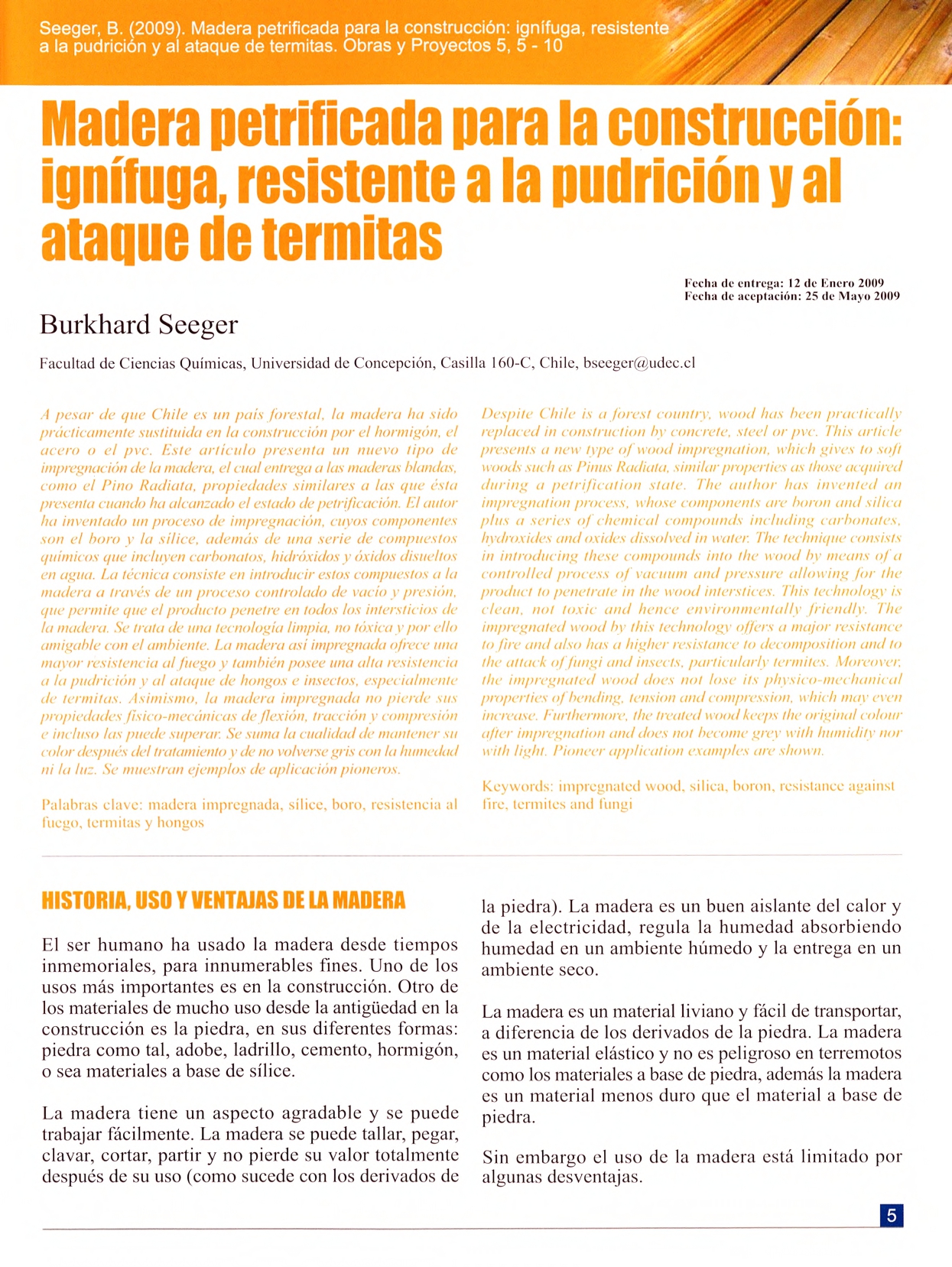
Petrified wood for construction: fireproof, resistant to rot and termite attack
DOI:
https://doi.org/10.21703/0718-2813.2009.5.3676Keywords:
impregnated wood, silica, boron, resistance against fire, termites and fungiAbstract
Despite Chile is a forest country, wood has been practically replacedin construction by concrete, steelor pve. This article
presents a new type of wood impregnation, which gives to sofi woods such as Pinus Radiata, similar properties as those acquired
during a petrification state. The author has invented an impregnation process, whose components are horon and silica plus a series of chemical compounds including carbonates, hydroxides and oxides dissolved in water. The technique consists in introducing these compounds into the wood by means of a controlled process of vacuum and pressure allowing for the product to penetrate in the wood interstices. This technology is clean, not toxic and hence environmentally friendly. The impregnated wood by this technology offers a major resistance to fire and also has a higher resistance to decomposition and to the attack of fungi and insects, particularly termites. Moreover, the impregnated wood does not lose its phvsico-mechanical properties of bending, tension and compression, which may even increase. Furthermore, the treated wood keeps the original colour after impregnationand does not become grey with humidity nor with light. Pioneer application examples are shown.
References
Berg, A., Seeger, B. y Navarrete, P. (2005). Proceso para la obtencion de tableros reconstruidos de madera, resistentes al fuego ybcon buenas propiedadades mecanicas. Solicitud de Patente de Invencion Chilena 1670-2005.
Downloads
Published
Issue
Section
License
Copyright (c) 2009 Universidad Católica de la Santísima Concepción

This work is licensed under a Creative Commons Attribution-NonCommercial 4.0 International License.