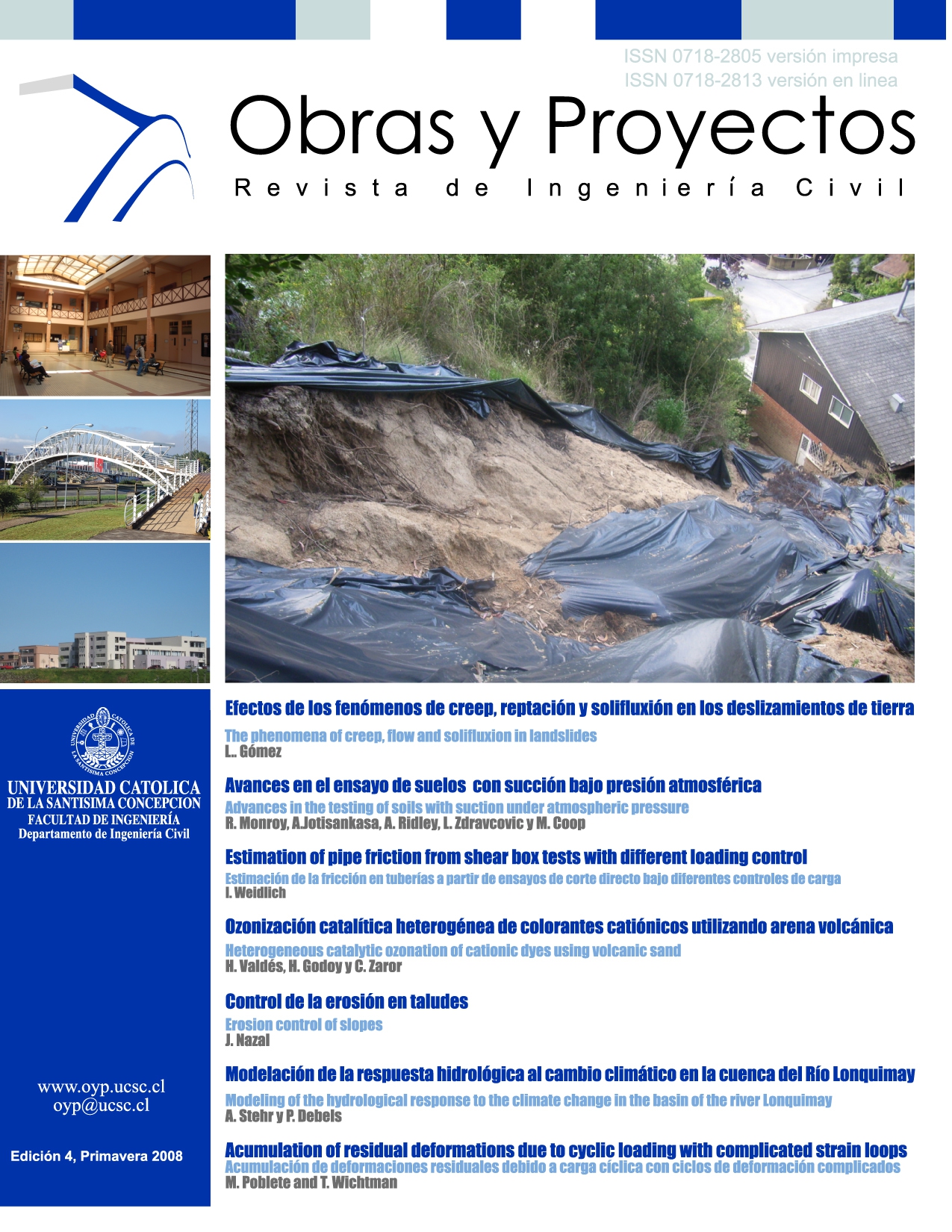
Modeling the hydrological response to climate change in the Lonquimay River basin
DOI:
https://doi.org/10.21703/0718-2813.2008.4.3674Keywords:
hydrological modeling, climate change, chileAbstract
During the past years a progressive change of the climatic conditions has been worldwide observed. This has brought as consequence an increases of the frequency and severity of phenomena like floods and droughts. It is then necessary 10 count on tools that allow making decisions in an informed way. Nowadays a form to evaluate the effect of climatic change on the hydrology of a basin is to use a distributed hydrologic model, which once calibrated and validated is disturbed with changes (% of precipitation change and change in the temperature) obtainedfrom future climatic scenarios. The objective of this work is to model the hydrologic response of an Andean sub-basin of the Biobio River to different climate change scenarios. Results indicate that for most of the modeled climate change scenarios a reduction in the magnitude of monthly and annual average flows is expected, being this variation greater at spring and summer.
References
Dankers, R. and O.B Christensen (2005)Climate change impact on snowcoverage, evaporation and river discharge in the sub-arctic Tana basin, Northern Fennoscandia. Climatic Change, Vol. 69, pp. 367-392. DOI: https://doi.org/10.1007/s10584-005-2533-y
García, A., Jorde, K., Habit, E. and Parra, O. (2007). Downstream
environmental effects of Ralco and Pangue Dam operations: changes in habitat quality for native fish species, Biobío River, Chile. 32 Congress of IAHR, The International Association of Hydraulic Engineering & Rescarch. Harmonizing the demands of art and nature in hydraulics, July 1-6 2007, Venice, Italy.
Gleick, P. H. (1986) Methods for evaluating the regional hydrologic impacts of global climatic changes. Journal of Hydrology Vol. 88, pp. 97-116. DOI: https://doi.org/10.1016/0022-1694(86)90199-X
Hulme, M., Wigley, T. M. L., Barrow, E. M., Raper, S. C. B., Centella, A., Smith, S. & Chipanshi, A. (2000) Using a climate scenario generator in vulnerability and adaptation assessments: MAGICC and SCENGEN Version 2.4 Workbook. Climatic Research Unit, University of East Anglia, Norwich, 60pp.
López-Moreno, J.I. and D. Nogués-Bravo (2005)A generalized additive model for the spatial distribution of snowpack in the Spanish Pyrenees Hydrological Processes, Vol. 19, pp. 3167-3176. Asses Theoretical Documentation. Version 2000. Texas Waler Resources Institute, College Station, Texas. DOI: https://doi.org/10.1002/hyp.5840
Neitsch, S.L., J.C. Arnold, J.R. Kiniry, J.R. Williams and K.W. King (2002). Soil and Water Assessment Tool Theoretical User's Manual. Version 2000. Texas Water Resources Institute, College Station, Texas.
Ruosteenoja, K., Carter, T. R., Jylhá, K. & Tuomenvirta, H. (2003) Future climate in world regions: an intercomparison of model-based projections for the new IPCC emissions scenarios. Finnish Environment Institute. Helsinki, Finland.
Stott, P.A., D.A. Stone, and M.R. Allen (2004) Human contribution to the European heatwave of 2003. Nature, Vol. 432, pp. 610-614. DOI: https://doi.org/10.1038/nature03089
Wigley, T. M. L. (2003) MAGICC/SCENGEN 4.1: User Manual, National Center for Atmospheric Research, Colorado, USA, October 2003, 23 pp.
Wigley, T.M.L., Raper, S. C. B., Hulme, M. & Smith, S. (2000) The MAGICC/SCENGEN Climate Scenario Generator: Version 2.4, Technical Manual, Climatic Research Unit, UEA, Norwich, UK, 48pp. The MAGICC/SCENGEN Climate Scenario Generator: Version 2.4, Technical Manual, Climatic Research Unit, UEA, Norwich, UK, 48pp.
Xu, C.Y. and V.P. Singh (2004) Review on Regional Water Resources Assessment Models under Stationary and Changing Climate”. Water Resources Management, Vol. 18, pp. 591 -612. DOI: https://doi.org/10.1007/s11269-004-9130-0
Yang, T.C., PS.Yu and C.C. Chen (2005) Long-termrunoff forecasting by combining hydrological models and meteorological records”.Hydrological Processes, Vol. 19, pp. 196 DOI: https://doi.org/10.1002/hyp.5658
Published
Issue
Section
License
Copyright (c) 2008 Universidad Católica de la Santísima Concepción

This work is licensed under a Creative Commons Attribution-NonCommercial 4.0 International License.