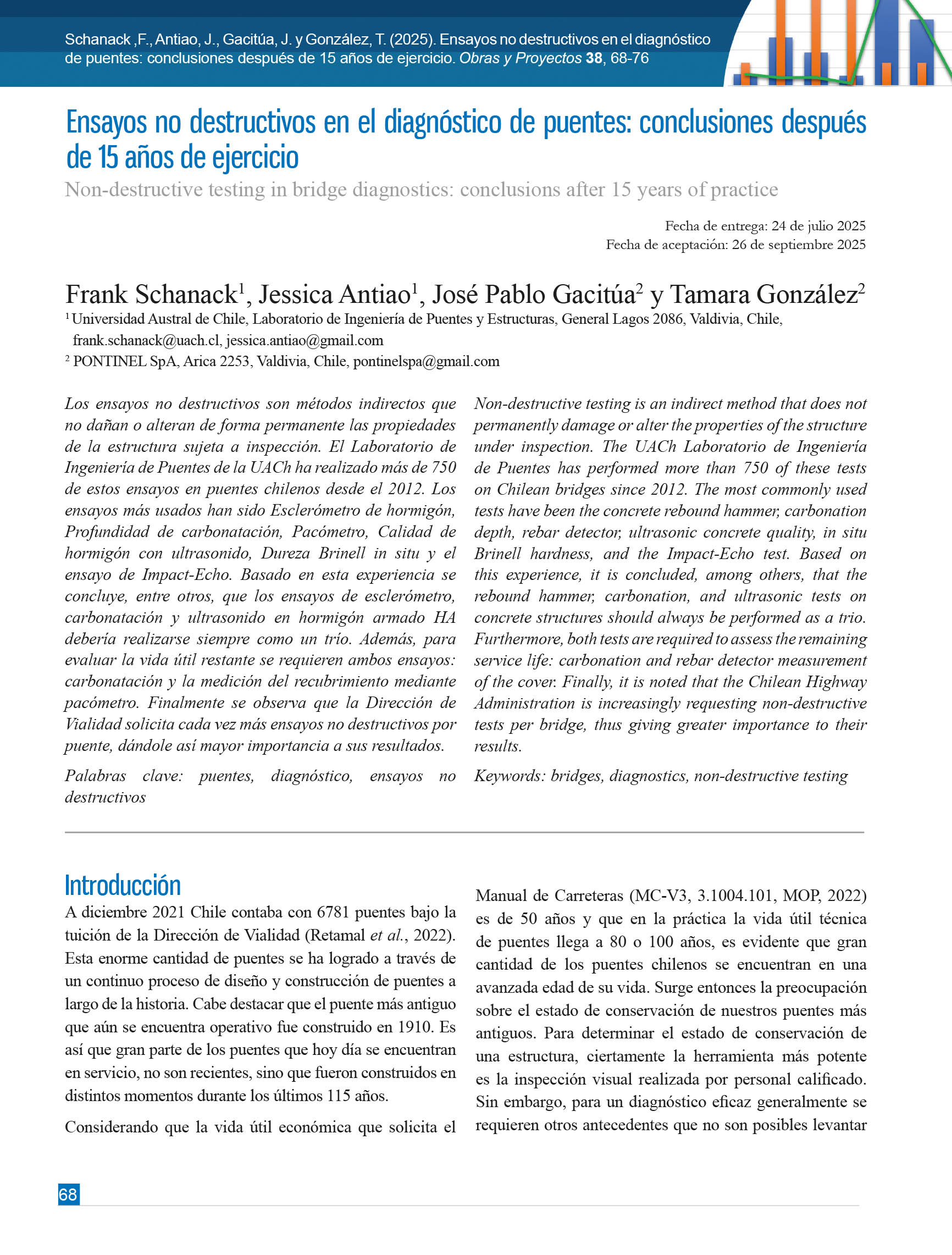
Ensayos no destructivos en el diagnóstico de puentes: conclusiones después de 15 años de ejercicio
DOI:
https://doi.org/10.21703/0718-2813.2025.38.3633Palabras clave:
Puentes, Diagnóstico, Ensayos no destructivosResumen
Los ensayos no destructivos son métodos indirectos que no dañan o alteran de forma permanente las propiedades de la estructura sujeta a inspección. El Laboratorio de Ingeniería de Puentes de la UACh ha realizado más de 750 de estos ensayos en puentes chilenos desde el 2012. Los ensayos más usados han sido Esclerómetro de hormigón, Profundidad de carbonatación, Pacómetro, Calidad de hormigón con ultrasonido, Dureza Brinell in situ y el ensayo de Impact-Echo. Basado en esta experiencia se concluye, entre otros, que los ensayos de esclerómetro, carbonatación y ultrasonido en hormigón armado HA debería realizarse siempre como un trío. Además, para evaluar la vida útil restante se requieren ambos ensayos: carbonatación y la medición del recubrimiento mediante pacómetro. Finalmente se observa que la Dirección de Vialidad solicita cada vez más ensayos no destructivos por puente, dándole así mayor importancia a sus resultados.
Referencias
Antiao, J. (2017). Estado del arte de los ensayos no destructivos en la ingeniería civil y diseño de un programa de ensayos para el Puente Calle Calle 1, Valdivia. Laboratorio de Ingeniería de Puentes, Universidad Austral de Chile.
García, A.R. (2007). Fundamentos a los ensayos no destructivos. Instituto Mexicano de Ensayos No Destructivos, México.
Hoła, J., Bien, J., Sadowski, L. and Schabowicz, K. (2015). Non-destructive and semi-destructive diagnostics of concrete structures in assessment of their durability. Bulletin of the Polish Academy of Sciences: Technical Sciences 63(1), 87-96.
ISO 18265 (2013). Metallic materials — Conversion of hardness values. Geneva, Switzerland.
MOP (2022). Instrucciones y criterios de diseño. Manual de Carreteras, Volumen 3. Ministerio de Obras Públicas, Santiago, Chile.
NCh170 (2016). Hormigón - Requisitos generales. Instituto Nacional de Normalización INN, Santiago, Chile.
Ramirez, R., Chagoyén, E. y Martirena, J.F. (2017). Caracterización de cambios de volumen en hormigones producidos en Cuba y sus aplicaciones. Obras y Proyectos 22, 18-30.
Retamal, J., Márquez, M. y Bianchi, E. (2022). Plan de puentes 2020 – 2030. Dirección de Vialidad, Ministerio de Obras Públicas, Registro de Propiedad Intelectual N° 2022-A-3364, Santiago, Chile.
Rudeli, N. y Santilli, A. (2017). Medición de resistencia a tempranas edades del hormigón: método que mejor se ajusta para la determinación de tiempos mínimos de desencofrado de elementos verticales de hormigón. Obras y Proyectos 22, 6-16.
Descargas
Publicado
Número
Sección
Licencia
Derechos de autor 2025 Universidad Católica de la Santísima Concepción

Esta obra está bajo una licencia internacional Creative Commons Atribución-NoComercial 4.0.