Manufacture and evaluation of pressed blocks made from recycled paper for thermoacoustic insulation
DOI:
https://doi.org/10.21703/0718-2813.2026.39.3584Keywords:
Recycled office paper, Non-structural building materials, thermoacoustic insulation, sustainability , circular economy in constructionAbstract
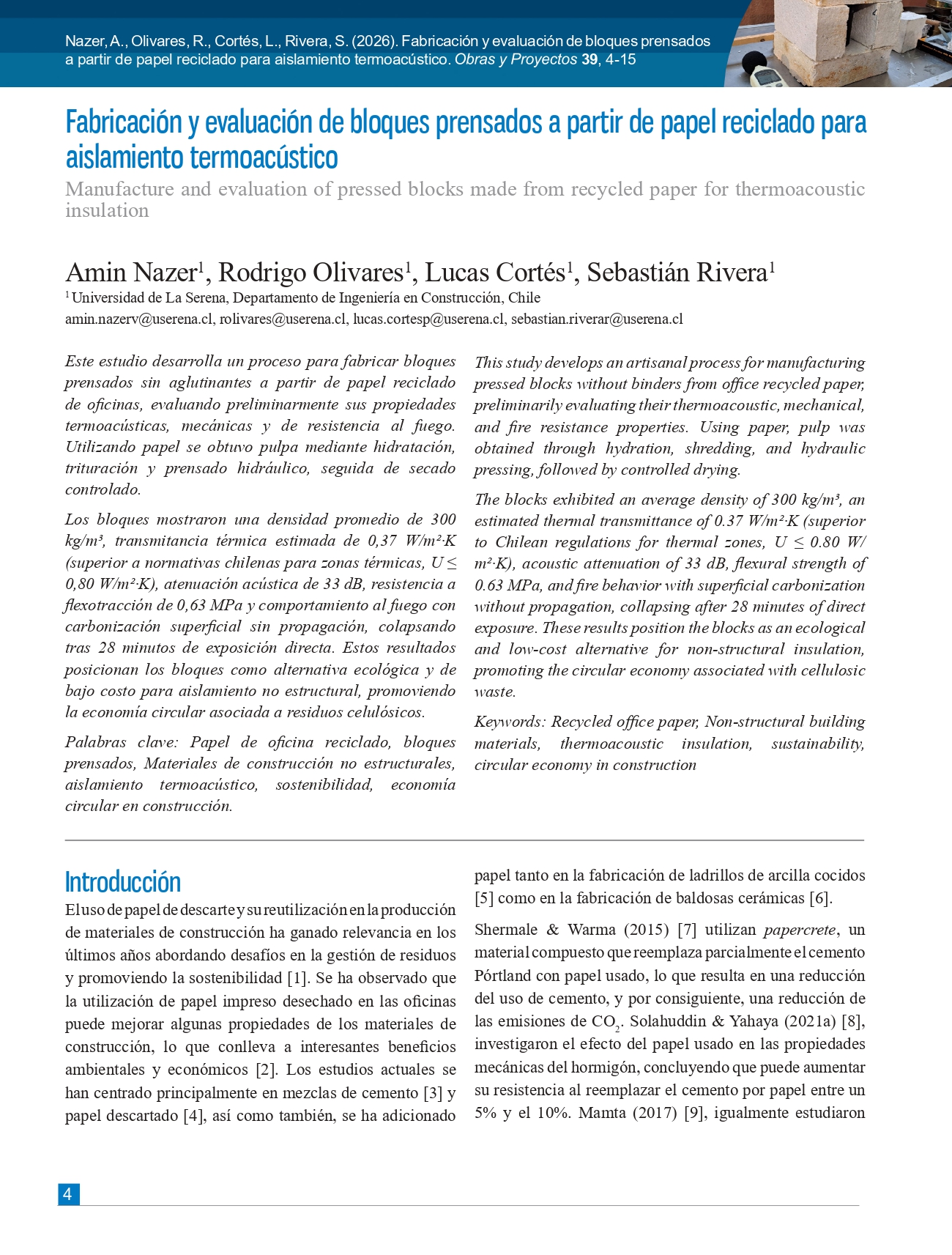
This study develops an artisanal process for manufacturing pressed blocks without binders from office recycled paper, preliminarily evaluating their thermoacoustic, mechanical, and fire resistance properties. Using paper, pulp was obtained through hydration, shredding, and hydraulic pressing, followed by controlled drying.
The blocks exhibited an average density of 300 kg/m³, an estimated thermal transmittance of 0.37 W/m²·K (superior to Chilean regulations for thermal zones, U ≤ 0.80 W/m²·K), acoustic attenuation of 33 dB, flexural strength of 0.63 MPa, and fire behavior with superficial carbonization without propagation, collapsing after 28 minutes of direct exposure. These results position the blocks as an ecological and low-cost alternative for non-structural insulation, promoting the circular economy associated with cellulosic waste.
References
[1] S. Sidabutar, MORFAI J. 3, 133 (2023). https://doi.org/10.54443/morfai.v3i1.838
[2] M. H. Iqbal and F. Ahmed, IOSR J. Environ. Sci. Toxicol. Food Technol. 9, 10 (2015). https://doi.org/10.9790/2402-09811017
[3] A. B. Al Zubaidi, S. R. Ahmedizat, and A. A. Al-Tabbakh, IOP Conf. Ser.: Mater. Sci. Eng. 870, 012138 (2020). https://doi.org/10.1088/1757-899X/870/1/012138
[4] Mamta, Anshu, and A. Singhal, Int. J. Eng. Res. Technol. (IJERT) 5, (3) (2016). https://doi.org/10.17577/IJERTCONV5IS03015
[5] K. S. Shibib, Heat Mass Transf. 51, 685 (2015). https://doi.org/10.1007/s00231-014-1438-6
[6] R. Afonso et al., Green Mater. Sustain. Water Remediation Treat. (Springer, 2018) pp. 1–10. https://doi.org/10.1007/978-3-030-10383-5_30
[7] Y. D. Shermale and M. B. Varma, Recent Trends Civ. Eng. Technol. 2, 54 (2015).
[8] B. A. Solahuddin and F. M. Yahaya, IOP Conf. Ser.: Mater. Sci. Eng. 1092, 012067 (2021a). https://doi.org/10.1088/1757-899X/1092/1/012067
[9] Mamta, Anshu, and A. Singhal, Int. J. Eng. Res. Technol. (IJERT) 5, (3) (2017). (ICADEMS – 2017).
[10] B. A. Solahuddin and F. M. Yahaya, Civ. Eng. J. 7, 94 (2022). https://doi.org/10.28991/CEJ-SP2021-07-07
[11] A. Solahuddin and F. M. Yahaya, IOP Conf. Ser.: Earth Environ. Sci. 682, 012006 (2021b). https://doi.org/10.1088/1755-1315/682/1/012006
[12] O. M. Okeyinka and O. J. Idowu, Eng. Technol. Appl. Sci. Res. 4, 724 (2014). https://doi.org/10.48084/etasr.485
[13] D. M. de Oliveira et al., Polymers 15, 426 (2023). https://doi.org/10.3390/polym15020426
[14] S. P. Sangeetha, R. Divahar, and P. S. Aravind Raj, Trends Ind. Eng. Appl. Manuf. Process (Springer, 2022) pp. 1–10. https://doi.org/10.9734/bpi/tier/v1/2363b
[15] V. Hospodarova, N. Stevulova, J. Briancin, and K. Kostelanska, Buildings 8, 43 (2018). https://doi.org/10.3390/buildings8030043
[16] S. Liuzzi, C. Rubino, F. Martellotta, and P. Stefanizzi, Appl. Sci. 13, 4710 (2023). https://doi.org/10.3390/app13084710
[17] T. Cardinale, M. D’Amato, R. Sulla, and N. Cardinale, Appl. Sci. 11, 1011 (2021). https://doi.org/10.3390/app11031011
[18] B. Mandili, M. Taqi, A. El Bouari, and M. Errouaiti, Constr. Build. Mater. 229, 117097 (2019). https://doi.org/10.1016/j.conbuildmat.2019.117097
[19] H. Hong, W. Huang, H. Zhao, X. Hong, and D. Hong, Polymers 13, 3119 (2021). https://doi.org/10.3390/polym13183119
[20] Biblioteca del Congreso Nacional, Ley Chile (2016). https://www.bcn.cl/leychile/navegar?idNorma=1090894
[21] I. A. Shah, S. Amjed, and N. A. Alkathiri, J. Bus. Econ. Manag. 20, 43 (2019). https://doi.org/10.3846/jbem.2019.6809
[22] U. W. Robert, S. E. Etuk, and O. E. Agbasi, Momento 71, 65 (2025). https://doi.org/10.15446/mo.n71.119616
[23] Grupo PCC, PCC Group Product Portal (2025). Recuperado 3 de octubre de 2025 de https://www.products.pcc.eu/es/k/industria-de-pulpa-y-papel/
[24] AMED, ¿De qué está hecho el papel? La ciencia detrás de la producción de papel (2025). https://amed-us.com/es/news/de-que-esta-hecho-el-papel-la-ciencia-detras-de-la-produccion-de-papel/
[25] K. Dölle, J. Eng. Res. Rep. 23, 39 (2022). https://doi.org/10.9734/jerr/2022/v23i317599
[26] V. Sangrutsamee, P. Srichandr, and N. Poolthong, J. Asian Archit. Build. Eng. 11, 147 (2012). https://doi.org/10.3130/jaabe.11.147
[27] Biblioteca del Congreso Nacional, Ley Chile (1992). https://www.bcn.cl/leychile/navegar?idNorma=8201
[28] Instituto Nacional de Normalización (INN), NCh1079:2019 ES. Arquitectura y construcción – Zonificación climática y térmica para el diseño de edificaciones (2019). https://ecommerce.inn.cl/nch10792019-es74937
[29] Instituto Nacional de Normalización (INN), NCh2785:2003 ISO 140-4:1998. Acústica – Medición de aislación acústica en construcciones y elementos de construcción – Mediciones en terreno de la aislación acústica aérea entre recintos (2003).
[30] ASTM, Standard Test Method for Laboratory Measurement of Airborne Sound Transmission Loss of Building Partitions and Elements (2016).
[31] Instituto Nacional de Normalización (INN), Hormigón – Ensayo de tracción por flexión (2009).
[32] Ministerio de Vivienda y Urbanismo, Nueva Reglamentación Térmica (2025). Recuperado 16 de octubre de 2025 de https://www.minvu.gob.cl/nueva-reglamentacion-termica/
Downloads
Published
Issue
Section
License
Copyright (c) 2026 Universidad Católica de la Santísima Concepción

This work is licensed under a Creative Commons Attribution-NonCommercial 4.0 International License.