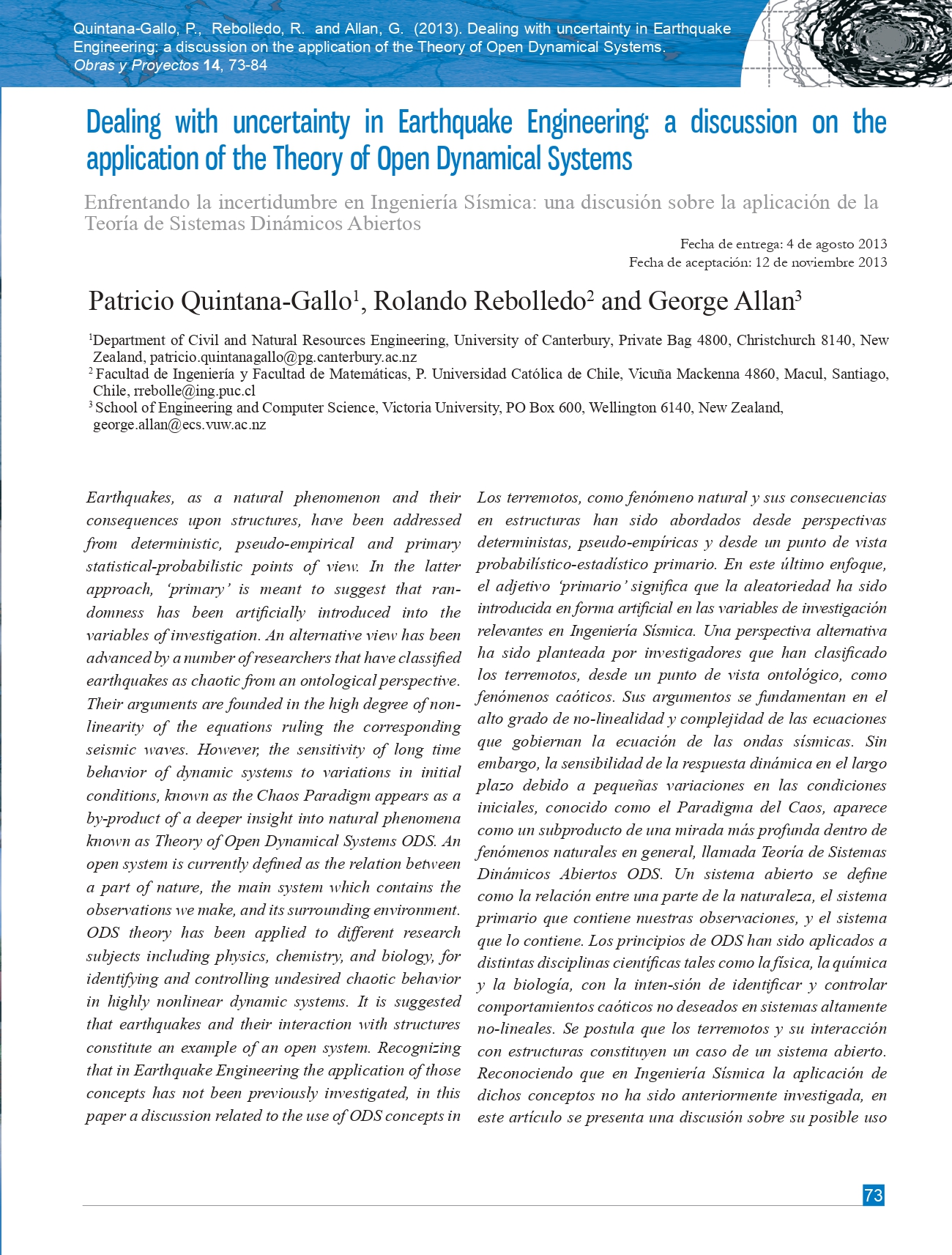
Enfrentando la incertidumbre en Ingeniería Sísmica: una discusión sobre la aplicación de la Teoría de Sistemas Dinámicos Abiertos
DOI:
https://doi.org/10.4067/S0718-28132013000200006Palabras clave:
Dinámica de estructuras, Incertidumbre sísmica, Caos, Sistemas dinámicos abiertos, Interacción sísmicaResumen
Los terremotos, como fenómeno natural y sus consecuencias en estructuras han sido abordados desde perspectivas deterministas, pseudo-empíricas y desde un punto de vista probabilístico-estadístico primario. En este último enfoque, el adjetivo ‘primario’ significa que la aleatoriedad ha sido introducida en forma artificial en las variables de investigación relevantes en Ingeniería Sísmica. Una perspectiva alternativa ha sido planteada por investigadores que han clasificado los terremotos, desde un punto de vista ontológico, como fenómenos caóticos. Sus argumentos se fundamentan en el alto grado de no-linealidad y complejidad de las ecuaciones que gobiernan la ecuación de las ondas sísmicas. Sin embargo, la sensibilidad de la respuesta dinámica en el largo plazo debido a pequeñas variaciones en las condiciones iniciales, conocido como el Paradigma del Caos, aparece como un subproducto de una mirada más profunda dentro de fenómenos naturales en general, llamada Teoría de Sistemas Dinámicos Abiertos ODS. Un sistema abierto se define como la relación entre una parte de la naturaleza, el sistema primario que contiene nuestras observaciones, y el sistema que lo contiene. Los principios de ODS han sido aplicados a distintas disciplinas científicas tales como la física, la química y la biología, con la inten-sión de identificar y controlar comportamientos caóticos no deseados en sistemas altamente no-lineales. Se postula que los terremotos y su interacción con estructuras constituyen un caso de un sistema abierto. Reconociendo que en Ingeniería Sísmica la aplicación de dichos conceptos no ha sido anteriormente investigada, en este artículo se presenta una discusión sobre su posible uso en dicha disciplina. Utilizando un modelo que representa el caso más básico de un oscilador de un grado de libertad con rigidez lineal elástica sometido sólo a un registro sísmico, se discuten las diferencias en la respuesta del oscilador obtenida usando la dinámica clásica de Newton y conceptos de ODS que incluyen procesos estocásticos como el que se utiliza en esta contribución. Conclusiones sobre las consecuencias de la aplicación de ODS son formuladas para re-entender la Ingeniería Sísmica, incorporando una crítica a enfoques probabilísticos primarios para abordar el mismo problema.
Referencias
Anagnos, T. and Kiremidjan, A. (1988). A review of earthquake occurrence models for seismic hazard analysis. Probabilistic Engineering Mechanics 3(1): 3-11.
Applebaum, D. (2004). Lévy Processes—From Probability to Finance and Quantum Groups, Notices of the AMS 52: 1336-1347.
Applebaum, D. (2009). Lévy processes and stochastic calculus. Cambridge Studies in Advanced Mathematics, Vol. 116.
Baker, J.W. and Cornell, C. A. (2006). Spectral shape, epsilon and record selection. Earthquake Engineering and Structural Dynamics 35: 1077-1095.
Baker, J.W. and Cornell, C. A. (2008). Uncertainty propagation in probabilistic seismic loss estimation. Structural Safety 30: 236-254.
Biot, M.A. (1943). Analytical and experimental methods in engineering seismology. Transactions of the American Society of Civil Engineers 108(1), 365-385.
Bolotin, V.V. (1960). Statistical theory of the aseismic design of structures. Proceedings of the Second WCEE, Tokyo, Japan, 1365-1373.
Chopra, A. K. (2001). Dynamics of structures. Theory and application to Earthquake Engineering. Prentice Hall, New Jersey.
Ditlevsen, O. and Bognár, L. (1993). Plastic displacement distributions of the Gaussian white noise excited elasto-plastic oscillator. Probability Engineering Mechanics 9: 209-231.
Fagnola, F., Rebolledo, R., and Saavedra, C. (1994). Quantum flows associated to master equations in quantum optics. Journal of Mathematical Physics 35(1):1–12.
Gamble, J. A., Wood, C. P., Price, R. C., Smith, I. E. M., Stewart, R. B., Waight, T. (1999). A fifty year perspective of magmatic evolution on Ruapehu Volcano, New Zealand: verification of open system behaviour in an arc volcano. Earth and Planetary Science Letters 170: 301-314.
Goodman, L.E., Rosenblueth, E. and Newmark, N.M. (1954). Aseismic design of elastic structures founded on firm ground. Proceedings of the ASCE Structural Division, Vol. 79, separate n. 239.
Housner, G.W., Martel, R.R., and Alfred, J.L. (1953). Spectrum analysis of strong-motion earthquakes. Bulletin of the Seismological Society of America 43 (2), 97-119.
Housner, G.W. (1947). Characteristics of strong-motion earthquakes. Bulletin of the Seismological Society of America 37 (2): 19-31.
Kloeden, E. and Platen, E. (1992). Numerical Solution of Stochastic Differential Equations. Springer-Verlag, Berlin.
Kossakowski, A. and Rebolledo, R. (2007). On non-Markovian time evolution in open quantum systems. Open Systems & Information Dynamics 14(3), 265-274.
Lorenz, E. (1963). Deterministic Non Periodic Flow. MIT Press, Massachusetts, USA.
Mackie, K. and Stojadinovic, B. (2004). Improving probabilistic seismic demand models through refined intensity measures. Proceedings of the 13th WCEE, Vancouver, Canada.
Platen, E., and Rebolledo R. (1985). Weak convergence of semimartingales and discretization methods. Stochastic Processes and their Applications 20: 41-58.
Popper, K. (1963). Conjectures and Refutations. Rouledge, New York, USA.
Priestley, M.J.N. (1998). Displacement-based approaches to Rational Limit States Design of New Structures. European Conference on Earthquake Engineering. Paris, France.
Priestley, M.J.N. (2003). Myths and Fallacies in Earthquake Engineering. IUSS Press, Pavia, Italy.
Priestley, M.J.N., Calvi, G.M. and Kowalsky, M. (2007). Displacement-based seismic design of structures. IUSS Press, Pavia, Italy.
Quintana-Gallo, P. (2008). Analytical evaluation of damage in an RC building with T-shaped walls. MSc thesis Universidad Técnica Federico Santa María, Valparaíso, Chile.
Quintana-Gallo, P., Akguzel, U., Pampanin, S. and Carr, A.J. (2011). Shake table tests of non-ductile as-built and repaired RC frames. Proceedings of the Pacific Conference on Earthquake Engineering, Auckland, New Zealand, paper 201.
Quintana-Gallo, P., Bonelli, P., Restrepo, J., Pampanin, P. and Carr, A.J. (2013)a. Seismic assessment of RC walls after the 27 February 2010 Maule Chile earthquake. Submitted to Journal of Earthquake Engineering.
Quintana-Gallo, P., Pampanin, P., Carr, A.J., Restrepo, J., and Bonelli, P. (2013)b. Seismic assessment of RC walls after the 22 February 2011 Canterbury New Zealand earthquake. Under submission process for the Journal of Earthquake Engineering (companion paper).
Rey-Bellet, L. (2006). Open Classical Sytems. In Open Quantum Systems II, The Markovian approach, 41-77, Springer, Berlin.
Rebolledo, R. (2004). Open quantum systems and classical trajectories. In Stochastic Analysis and Mathematical Physics (SAMP/ANESTOC 2002), 141–164. World Sci. Publishing, River Edge, NJ.
Rebolledo, R. (1979). La méthode des martingales appliquée à l’étude de la convergence en loi de processus. Mémoires de la Société Mathematique de France 62, i-v, 1-125.
Rebolledo R. (1980). Central limit theorems for local martingales. Zeitschrift für Wahrscheinlichkeitstheorie und Verwandte Gebiete 51: 269-286.
SEAOC (1995). Performance based seismic engineering of buildings. Vision 2000 Committee. Structural Engineers Association of California, Sacramento, CA.
Standards New Zealand (2002). NZS1170.1 - Structural design actions: Part 1, General Principles. Wellington, NZ.
Standards New Zealand (2004). NZS1170.5 – Structural design action: Part 5, Earthquake Actions. Wellington, NZ.
Strogatz, S. (1994). Nonlinear Dynamics and Chaos. Westview Press, Cambridge MA, USA.
Suzuki, Y., and Minai, R. (1988). Application of stochastic differential equations to seismic reliability analysis of hysteretic structures. Probabilistic Engineering Mechanics 3, n.1, 43-52.
Uma, S.R., Pampanin, S. and Christopoulos, C. (2010). Development of a probabilistic framework for performance-based seismic assessment of structures considering residual deformations. Journal of Earthquake Engineering 14(7): 1092-1111.
von Bertalanffy, L. (1950)a. An Outline of General System Theory. British Journal of the Philosophy of Science 1: 134-164.
von Bertalanffy, L. (1950)b. The Theory of Open Systems in Physics and Biology. Science 111: 23-29
Descargas
Publicado
Número
Sección
Licencia
Derechos de autor 2013 Universidad Católica de la Santísima Concepción

Esta obra está bajo una licencia internacional Creative Commons Atribución-NoComercial 4.0.