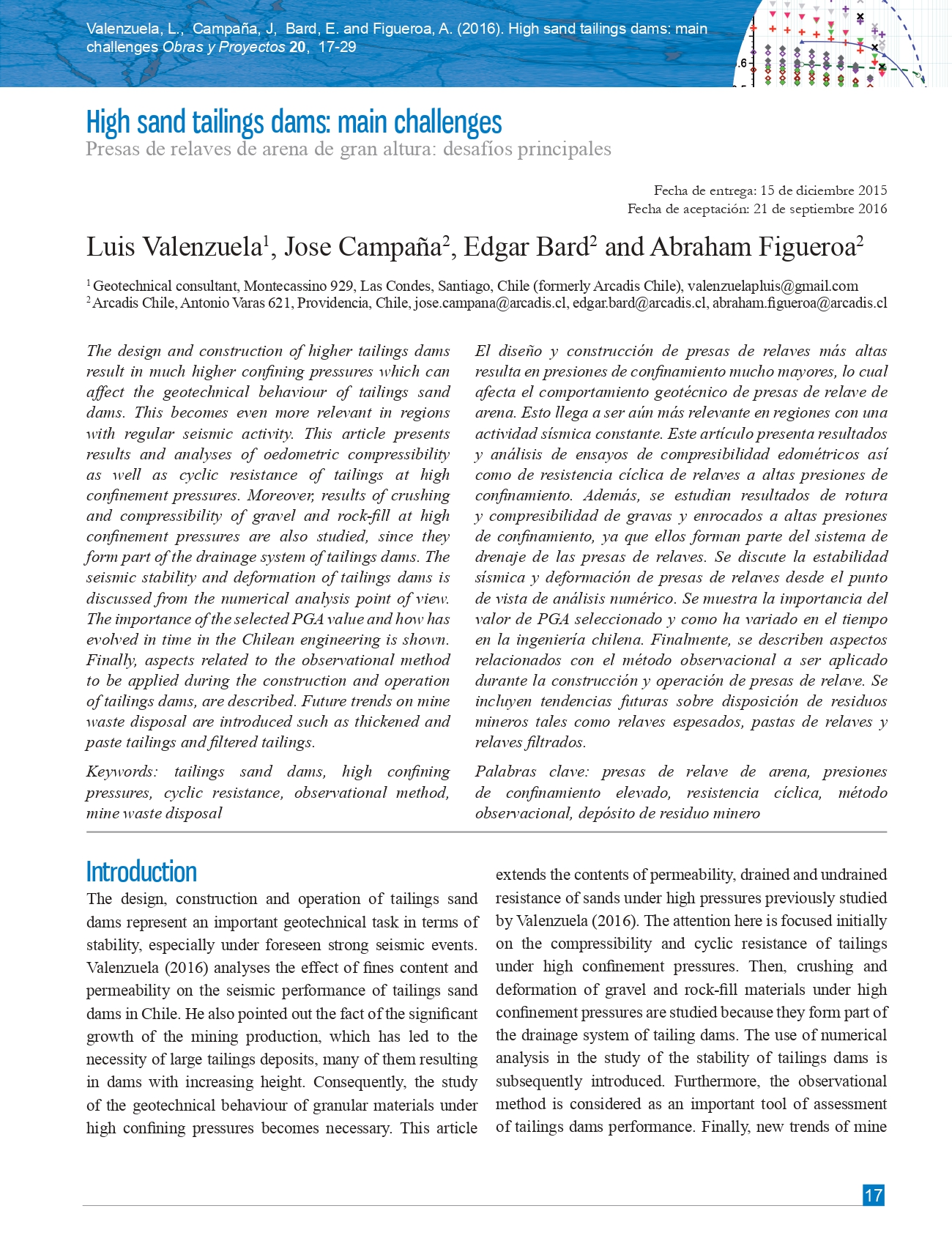
High sand tailings dams: main challenges
DOI:
https://doi.org/10.4067/S0718-28132016000200002Keywords:
Tailings sand dams, High confining pressures, Cyclic resistance, Observational method, Mine waste disposalAbstract
The design and construction of higher tailings dams result in much higher confining pressures which can affect the geotechnical behaviour of tailings sand dams. This becomes even more relevant in regions with regular seismic activity. This article presents results and analyses of oedometric compressibility as well as cyclic resistance of tailings at high confinement pressures. Moreover, results of crushing and compressibility of gravel and rock-fill at high confinement pressures are also studied, since they form part of the drainage system of tailings dams. The seismic stability and deformation of tailings dams is discussed from the numerical analysis point of view. The importance of the selected PGA value and how has evolved in time in the Chilean engineering is shown. Finally, aspects related to the observational method to be applied during the construction and operation of tailings dams, are described. Future trends on mine waste disposal are introduced such as thickened and paste tailings and filtered tailings.
References
Ambraseys, N.N. (1960). The seismic stability of earth dams, Proceedings of the 2nd World Conference on Earthquake Engineering, Tokyo, Japan, Vol. 2, 1345-1363.
Ávila, J. (2011). The drained stacking of granular tailings: a disposal method for a low degree of saturation of the tailings mass. Proceedings of Tailings and Mine Waste, Vancouver.
Bard, E., Campaña, J., Valenzuela, L., Figueroa, A. and Marilao, P. (2015). Mine waste rock and riverbed materials at high pressures; applications for high waste rock dumps and high tailings dams design. XV Pan-American Conference on Soil Mechanics and Geotechnical Engineering, Buenos Aires.
Bard, E., Campaña, J., Torres, P., Valenzuela, L. y Cifuentes, L. (2014). Comportamiento de arenas a altas presiones de confinamiento: comparación entre arenas de relaves y naturales. VIII Congreso Chileno de Geotecnia, Santiago.
Bard, E., Anabalón, M. and Campaña, J. (2012). Waste rock behavior at high pressures: dimensioning high waste rock dumps. In Multiscale Geomechanics, ed. by P.-Y. Hicher, ISTE/Wiley, 86-112.
Bard, E., Campaña, J., Anabalón, M. and Apablaza, R. (2007). Waste rock behavior under high pressures. XIII Pan-American Conference on Soil Mechanics and Geotechnical Engineering, Venezuela.
Bray, J.D. and Travasarou, T. (2011). Pseudostatic slope stability procedure. 5th International Conference on Earthquake Geotechnical Engineering, Santiago.
Bray, J.D. and Travasarou, T. (2009). Pseudostatic coefficient for use in simplified seismic slope stability evaluation. Journal of Geotechnical and Geoenvironmental Engineering 135(9), 1336 – 1340.
Bray, J.D. and Travasarou, T. (2007). Simplified procedure for estimating earthquake-induced deviatoric slope displacements. Journal of Geotechnical and Geoenvironmental Engineering 133(4), 381 – 392.
Bureau, G., Volpe, R.L. Roth, W.H. and Udaka, T. (1985). Seismic analysis of concrete face rockfill dams. Proceedings of the Symposium on Concrete Face Rockfill Dams – Design, Construction and Performance, ASCE, 479 – 508.
Byrne, P.M. (1991). A cyclic shear-volume coupling and pore pressure model for sand. Proceedings of the 2nd International Conference on Recent Advances in Geotechnical Earthquake Engineering and Soil Dynamics, 47-55.
Colliat-D’Angus, J.L. (1986). Comportement des matériaux granulaires sous fortes contraintes. Influence de la nature minéralogique du matériau étudié. Doctorate thesis Université Scientifique et Médicale de Grenoble.
Duncan, J., Wright, S.G. and Brandon, T.L. (2014). Soil strength and slope stability. John Wiley & Sons, 2nd edition.
Duncan, J.M. and Chang, C.M. (1970). Nonlinear analysis of stress and strain in soils, Journal of Soil Mechanics and Foundations Division 96-SM5, 1629-1653.
Finn W.D.L. (2000). State of art of geotechnical earthquake engineering practice. Soil Dynamics and Earthquake Engineering 20(1), 1-15.
Finn, W.D.L. (1996). Seismic design and evaluation of tailings dams: state of the art. Proceedings International Symposium on Seismic and Environmental Aspects of Dams Design: Earth, Concrete and Tailings Dams, ICOLD – ISSMFE, Chilean Geotechnical Society, 7-34.
Hynes-Griffin, M.E. and Franklin, A.G. (1984). Rationalizing the seismic coefficient method. U.S. Army Corps of Engineers, Waterways Experiment Station, Miscellaneous Paper GL-84-13.
ICOLD (1986). Earthquake analysis procedures for dams – state of art. Bulletin 52.
Illanes, J., Urquidi, J., Figueroa, A., Campaña, J. and Morales, F. (2015). Geotechnical instrumentation in tailings sand dams. XV Pan-American Conference on Soil Mechanics and Geotechnical Engineering, Buenos Aires.
Makdisi, F.I. and Seed, H.B. (1978). Simplified procedure for estimating dam and embankment earthquake-induced deformations. Journal of the Geotechnical Engineering Division 104(7), 849-867.
Marcuson, W.F., Hynes, M.E. and Franklin, A.G. (2007). Seismic design and analysis of embankment dams: the state of practice. Proceedings of the 4th Civil Engineering Conference in the Asian Region, Taipei.
Marsal , R. y Resendiz, D. (1975). Presas de tierra y enrocamiento. Editorial Limusa, 221-267.
Marsal, R. (1977). Research on granular materials (rockfill and soilgravel mixtures). Universidad Nacional Autónoma de México.
Martin, T.E, Davies, M.P., Rice, S., Higgs, T. and Lighthall, P.C. (2002). Stewardship of tailings facilities. Mining, Minerals and Sustainable Development No. 20. International Institute for Environment and Development.
Martin, G.R. (1975). Fundamentals of liquefaction under cyclic loading. Journal of the Geotechnical Engineering Division 101(5), 423-438.
MM (2007). Decreto Supremo Nº 248. Reglamento para la aprobación de proyectos de diseño, construcción, operación y cierre de los depósitos de relaves. Ministerio de Minería de Chile.
Morgenstern, N., Van Zyl, D. and Vick, S.G. (2015). Independent expert engineering investigation and review panel. Report on Mount Polley Tailings Storage Facility Breach.
Morgenstern, N.R. (1996). Geotechnics and mine waste management. Keynote Lecture, In International Symposium on Seismic and Environmental Aspects of Dams Design: Earth, Concrete and Tailings.
Murthy, T. Loukidis, D. Carrasco, J. Prezzi, M. and Salgado, R. (2007). Undrained monotic response of clean and silty sands. Géotechnique 57(3), 273-288.
Newman, L. Arnold, K. and Wittwer, D. (2010). Dry stack tailings design for the Rosemont Copper project. International Conference on Tailings and Mine Waste, Vol. 10, 315-326.
Newmark, N. (1965). Effects of earthquake on dams and embankments. Géotechnique 15(2), 139-160.
Ozkan, Y. (1998). A review of considerations on seismic safety of embankment and earth and rock-fill dams. Soil Dynamics and Earthquake Engineering 17(7), 439-458.
Peck, R.B. (1980). Where has all the judgement gone?. The 5th Laurits Bjerrum Memorial Lecture. Canadian Geotechnical Journal 17(4), 584-590.
Priscu, C. (2014). Conceptos de seguridad de los depósitos de relaves y posición de Anglo American al respecto. Presentación interna ARCADIS Chile.
Sarma, S.K. (1975). Seismic stability of earth dams and embankments. Géotechnique 25(4), 743-761.
Seed, H.B. (1979). Considerations in the earthquake-resistant design of earth and rockfill dams. Géotechnique 29(3), 215-263.
Swaisgood, J.R. (2003). Embankment dam deformations caused by earthquakes. Proceedings of the Pacific Conference on Earthquake Engineering, Christchurch, New Zealand.
Valenzuela, L. (2016). Design, construction, operation and the effect of fines content and permeability on the seismic performance of tailings sand dams in Chile. Obras y Proyectos 19, 6-22.
Valenzuela, L. (2015). Tailings dams and hydraulic fills. Casagrande Lecture, XV Pan-American Conference on Soil Mechanics and Geotechnical Engineering, Buenos Aires, Argentina.
Downloads
Published
Issue
Section
License
Copyright (c) 2016 Universidad Católica de la Santísima Concepción

This work is licensed under a Creative Commons Attribution-NonCommercial 4.0 International License.