Tridimensional analysis of the dynamic behaviour of a fortification under an induced seismic event
DOI:
https://doi.org/10.4067/S0718-28132017000100008Keywords:
Rockburst, Energy demand, Flac3D, Rockmass, Seismic event, Seismic energyAbstract
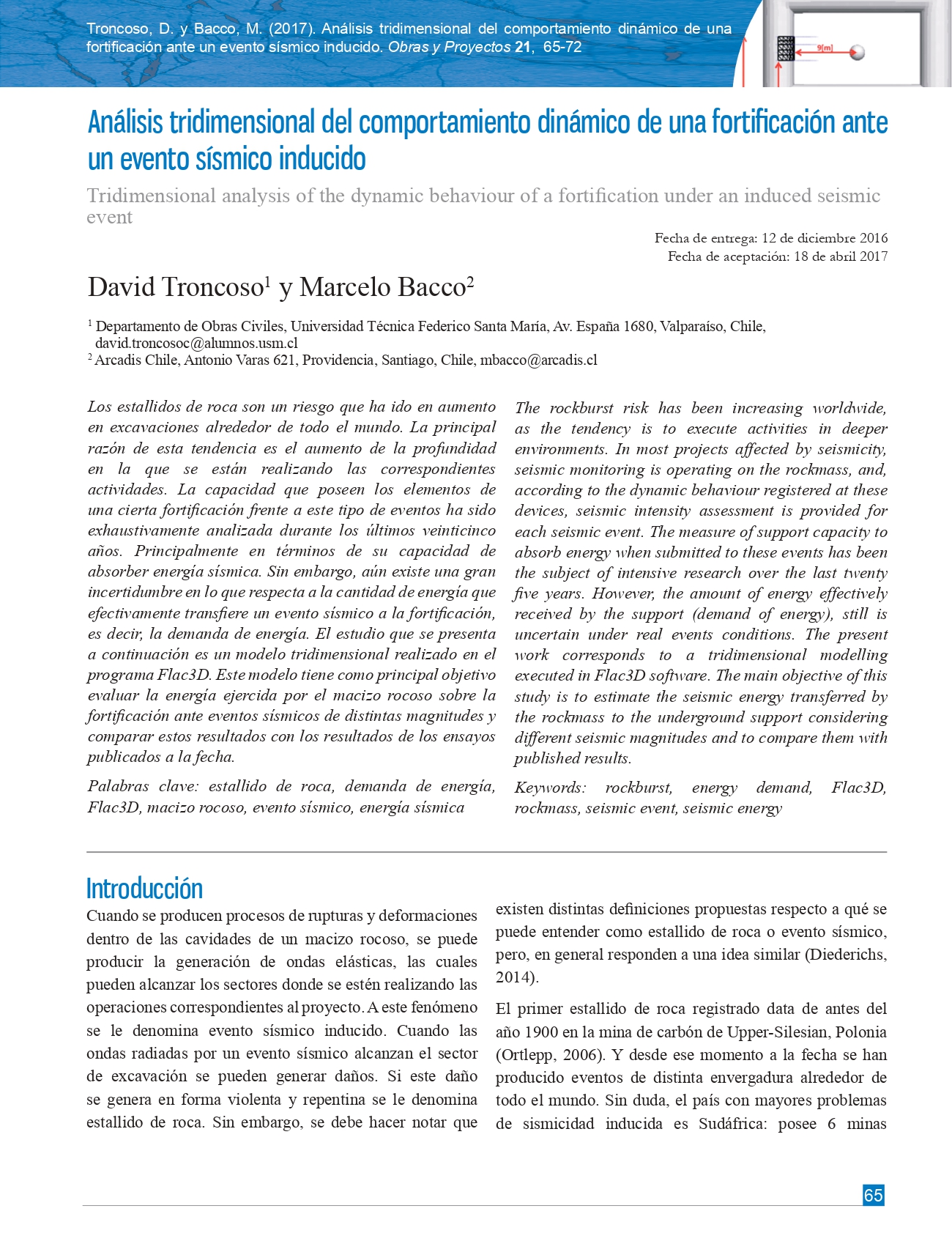
The rockburst risk has been increasing worldwide, as the tendency is to execute activities in deeper environments. In most projects affected by seismicity, seismic monitoring is operating on the rockmass, and, according to the dynamic behaviour registered at these devices, seismic intensity assessment is provided for each seismic event. The measure of support capacity to absorb energy when submitted to these events has been the subject of intensive research over the last twenty five years. However, the amount of energy effectively received by the support (demand of energy), still is uncertain under real events conditions. The present work corresponds to a tridimensional modelling executed in Flac3D software. The main objective of this study is to estimate the seismic energy transferred by the rockmass to the underground support considering different seismic magnitudes and to compare them with published results.
References
Barton, N., Lien, R. and Lunde, J. (1974). Engineering classification of rock masses for the design of tunnel support. Rock Mechanics 6(4), 189-236.
Brummer, R.K. (1999). Simple truths about rockbursts. Second South African Rock Engineering Symposium, SARES 99, ISRM Regional Symposium, Johannesburg.
Cai, M., Kaiser, P.K., Tasaka, Y. and Minami, M. (2007). Determination of residual strength parameters of jointed rock masses using the GSI system. International Journal of Rock Mechanics & Mining Sciences 44(2), 247-265.
Diederichs, M.S. (2014). When does brittle failure become violent? Spalling and rockburst characterization for deep tunneling projects. World Tunnel Congress 2014. Iguassu Falls, Brazil, 1-10.
Farmer, I.W. (1968). Engineering properties of rocks. E & FN Spon.
Flac3D (2013). Fast Lagrangian Analysis of Continua in 3 Dimensions. Dynamic Analysis. Itasca Consulting Group.
Goodman, R.E. (1989). Introduction to rock mechanics. John Wiley & Sons.
Heal, D. (2010). Observations and analysis of incidences of rockburst damage in underground mines. PhD thesis, The University of Western Australia, Perth, Australia.
Hoek, E. and Diederichs, M.S. (2006). Empirical estimation of rock mass modulus. International Journal of Rock Mechanics and Mining Sciences 43(2), 203-215.
Hoek, E. and Brown, E.T. (1980). Underground excavation in rock. The Institution of Mining and Metallurgy, London.
Hoek, E., Carranza-Torres, C. and Corkum, B. (2002). HoekBrown criterion – 2002 edition. 5th North American Rock Mechanics Symposium and the 17th Tunnelling Association of Canada Conference NARMS-TAC, Toronto, 1, 267-273.
Johnson, R.B. and de Graff, J. (1988). Principles of engineering geology. John Wiley and Sons.
Kagoorlie Miner (1917). Sensational mining fatality, severe earth tremor causes fall of rock on Great Boulder mine, one man killed, others injured. Kalgoorlie, Western Australia.
Kaiser, P.K., McCreath, D.R. and Tannant, D.D. (1996). Canadian rockburst support handbook. Geomechanics Research Centre, Laurentian University, Sudbury.
Kramer, S.L. (1996). Geotechnical Earthquake Engineering. Prentice Hall.
Mellick, A.G. (2007). Beaconsfield Investigation Report – Prepared for the Coroner at the request of the Tasmanian Government concerning the incident resulting in the death of Larry Knight and the entrapment of Todd Rusell and Brant Webb which occurred at Beaconsfield Mine on 25th April 2006. Tasmanian Coroners Court, Australia.
Mikula, P.A. and Poplawski, R.F. (1995). The seismic monitoring decision at Mt Charlotte gold mine. Underground Operators Conference, AusIMM, Kalgoorlie, 79-85.
Obert, L. and Duval, W.I. (1967). Rock mechanics and the design of structures in rock. John Wiley and Sons.
Ortlepp, W.D. (2006). RaSiM comes of age – a review of the contribution of the understanding and control of mine rockburst. Sixth International Symposium on Rockburst and Seismicity in Mines, Potvin and Hudyma eds., Perth, Australia, 9-11.
Ortlepp, W.D. (1992). The design of support for the containment of rockburst damage in tunnels - an engineering approach. Rock Support in Mining and Underground Construction, Kaiser and McCreath eds., 593-609.
Ortlepp, W.D. and Stacey, T.R. (1994).The need for yielding support in rockburst conditions, and realistic testing of rockbolts. International Workshop on Applied Rockburst Research, Cereceda and Van Sint Jan eds., Santiago, Chile, 249–259.
Pizarro, N. (2014). Oficio N° 5637 a Cámara de Diputados. Accidente fatal Señor José Orellana Ballesteros. CODELCO Chile.
Potvin, Y. (2009). Strategies and tactics to control seismic risk in mines. Journal of the Southern African Institute of Mining and Metallurgy 109(3), 177-186.
Potvin, Y., Wasseloo, J. and Heal, D. (2010). An interpretation of ground support capacity submitted to dynamic loading. Mining Technology 119(4), 233-245.
Potvin, Y., Hadjigeorgiou, J. and Stacey, T.R. (2007). Introduction. Challenges in Deep and High Stress Mining, Potvin et al. eds., Australian Centre for Geomechanics, Perth, Australia, 1–12.
Potvin, Y., Hudyma, M. and Jewell, R.J. (2000). Rockburst and seismic activity in underground Australian mines-an introduction to a new research project. ISRM International Symposium, International Society for Rock Mechanics, Melbourne, Australia.
Rahn, P.H. (1986). Engineering geology. An environmental approach. Elsevier.
Rauert, N.S. and Tully, K.P. (1998). Integration of a microseismic monitoring system in mining the Pasminco Broken Hill Southern Cross Area. 7th AusIMM Undergroud Operators Conference, Townsville, Queensland, Australia.
Walthan, T. (1999). Foundations of engineering geology. E & FN Spon.
Wyllie, D.C. (1999). Foundations on rock. 2° ed. E & FN Spon.
Downloads
Published
Issue
Section
License
Copyright (c) 2017 Universidad Católica de la Santísima Concepción

This work is licensed under a Creative Commons Attribution-NonCommercial 4.0 International License.