Numerical modelling of the formation and instability of blocks around the Monte Seco tunnel excavated in a discontinuous rock mass
DOI:
https://doi.org/10.4067/S0718-28132017000100007Keywords:
Tunnel in rock, Block/wedge, Fracture systems, Foliation plane, FEM, DFNAbstract
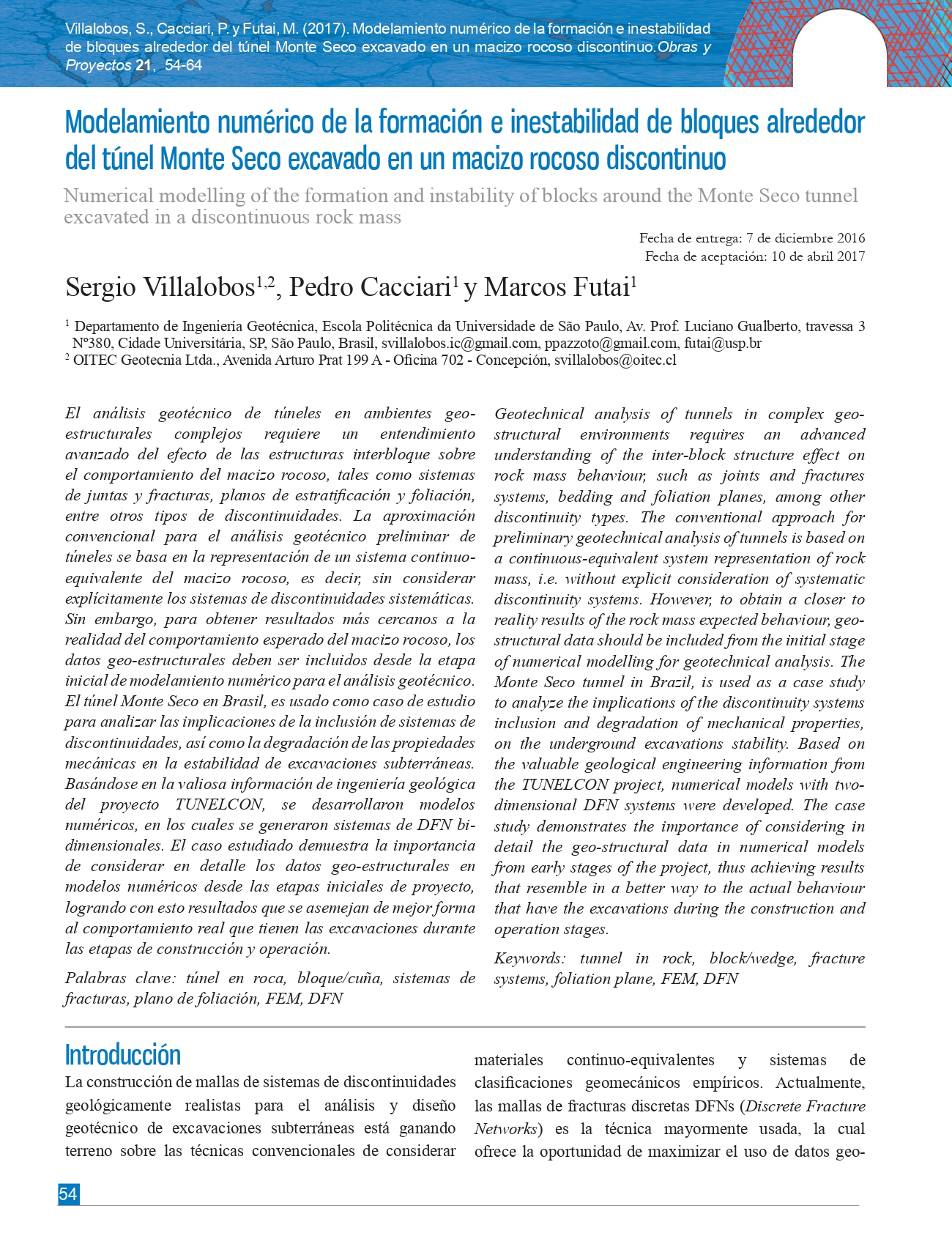
Geotechnical analysis of tunnels in complex geostructural environments requires an advanced understanding of the inter-block structure effect on rock mass behaviour, such as joints and fractures systems, bedding and foliation planes, among other discontinuity types. The conventional approach for preliminary geotechnical analysis of tunnels is based on a continuous-equivalent system representation of rock mass, i.e. without explicit consideration of systematic discontinuity systems. However, to obtain a closer to reality results of the rock mass expected behaviour, geostructural data should be included from the initial stage of numerical modelling for geotechnical analysis. The Monte Seco tunnel in Brazil, is used as a case study to analyze the implications of the discontinuity systems inclusion and degradation of mechanical properties, on the underground excavations stability. Based on the valuable geological engineering information from the TUNELCON project, numerical models with twodimensional DFN systems were developed. The case study demonstrates the importance of considering in detail the geo-structural data in numerical models from early stages of the project, thus achieving results that resemble in a better way to the actual behaviour that have the excavations during the construction and operation stages.
References
Baecher, G.B., Lanney, N.A. and Einstein, H.H. (1977). Statistical description of rock properties sampling. 18th US Symposium on Rock Mechanics.
Bandis, S., Lumsden, A.C. and Barton, N.R. (1981). Experimental studies of scale effects on the shear behaviour of rock joints. International Journal of Rock Mechanics and Mining Sciences & Geomechanics Abstracts 18(1), 1-21.
Barrios, B. (2014). Caracterização da rugosidade. Relatório de Iniciação Cientifica, Escola Politécnica da Universidade de São Paulo.
Barton, N., Bandis, S. and Bakhter, K. (1985). Strength, deformation and conductivity of rock joints. International Journal of Rock Mechanics and Mining Sciences & Geomechanics Abstracts 22(3), 121-140.
Barton, N. and Choubey, V. (1977). The shear strength of rock joints in theory and practice. Rock Mechanics & Rock Engineering 10(1), 1-54.
Bieniawski, Z.T. and Bernede, M.J. (1979). Suggested methods for determining the uniaxial compressive strength and deformability of rock materials. International Journal of Rock Mechanics and Mining Sciences & Geomechanical Abstracts 16(2), 138-140.
Cacciari, P. (2014). Estudo de um túnel em maciço rochoso fraturado por investigação geológico – geotécnica e analise pelo método dos elementos distintos. Tesis MSc, Escola Politécnica da Universidade de São Paulo.
Cacciari, P. and Futai, M. (2015). Modelling a railway rock tunnel using terrestrial laser scanning and the distinct element method. South American Rock Mechanics Symposium, ISRM Specialized Conference, Buenos Aires, Argentina, 101-108.
Cacciari, P. and Futai, M. (2016a). Mapping and characterization of rock discontinuities in a tunnel using 3D terrestrial laser scanning. Bulletin of Engineering Geology and the Environment 75(1), 223-237.
Cacciari, P. and Futai, M. (2016b). Integrating terrestrial laser scanning and discrete fracture network approaches for tunnel modelling in fractured rock masses. VII Brazilian Symposium on Rock Mechanics, ISRM Specialized Conference, Belo Horizonte, Brazil.
Call, R.D., Savely, J.P. and Nicholas, D.E. (1976). Estimation of joint set characteristics from surface mapping data. 17th US Symposium on Rock Mechanics, 2B2-1-9.
Diederichs, M. (2007). Mechanistic interpretation and practical application of damage and spalling prediction criteria for deep tunnelling. Canadian Geotechnical Journal 44(9), 1082-1116.
Elmo, D., Liu, Y. and Rogers, S. (2014). Principles of discrete fracture network modelling for geotechnical applications. First International DFNE Conference, Vancouver, Canada, paper 238.
Hoek, E., Carranza-Torres, C. and Corkum, B. (2002). HoekBrown criterion – 2002 edition. 5th North American Rock Mechanics Symposium and the 17th Tunnelling Association of Canada Conference NARMS-TAC, Toronto, 1, 267-273.
Hasui, Y., Carneiro, C.D.R., Almeida, F.D. and Bartorelli, A. (2012). Geologia do Brasil. São Paulo, Beca.
Ito, W. (2016). Contribuição ao estudo de instabilidade em tuneis não revestidos da estrada de ferro Vitória-Minas através da teoria dos blocos-chave e caracterização da rocha através de ensaios de laboratório e campo. Tesis MSc, Escola Politécnica da Universidade de São Paulo.
Kulatilake, P.H.S.W. and Wu, T.H. (1984). Estimation of mean trace length of discontinuities. Rock Mechanics & Rock Engineering 17(4), 215-232.
McMahon, B. (1974). Design of rock slopes against sliding on preexisting surface. 3rd International Symposium on Rock Mechanics, 803-808.
Monticelli, J. (2014). Contribuição ao conhecimento dos condicionantes geológicos – geotécnicos do túnel Monte Seco. Relatório de Iniciação Cientifica, Escola Politécnica da Universidade de São Paulo.
Monticelli, J., Cacciari, P., Susuki, S. e Futai, M. (2014). Correlação entre índices físicos e analise petrográfica na determinação do grau de alteração de um gnaisse. VI Brazilian Symposium on Rock Mechanics, ISRM Specialized Conference, Goiania, Brazil.
Priest, S.D. and Hudson, J.A. (1981). Estimation of discontinuity spacing and trace length using scanline surveys. International Journal of Rock Mechanics and Mining Sciences & Geomechanical Abstracts 18(3), 183-197.
RS2 (2015). Finite element analysis for excavations and slopes software. Version 8.0, Rocscience Inc., Toronto.
Ulusay, R. (2015). The ISRM suggested methods for rock characterization, testing and monitoring: 2007-2014. International Society of Rock Mechanics ISRM. Springer.
Villaescusa, E. and Brown, E.T. (1992). Maximum likelihood estimation of joint size from trace length measurements. Rock Mechanics & Rock Engineering 25(2), 67-87.
Zhang, L. and Einstein, H.H. (2000). Estimating the intensity of rock discontinuities. International Journal of Rock Mechanics & Mining Sciences 37(5), 819-837.
Downloads
Published
Issue
Section
License
Copyright (c) 2017 Universidad Católica de la Santísima Concepción

This work is licensed under a Creative Commons Attribution-NonCommercial 4.0 International License.