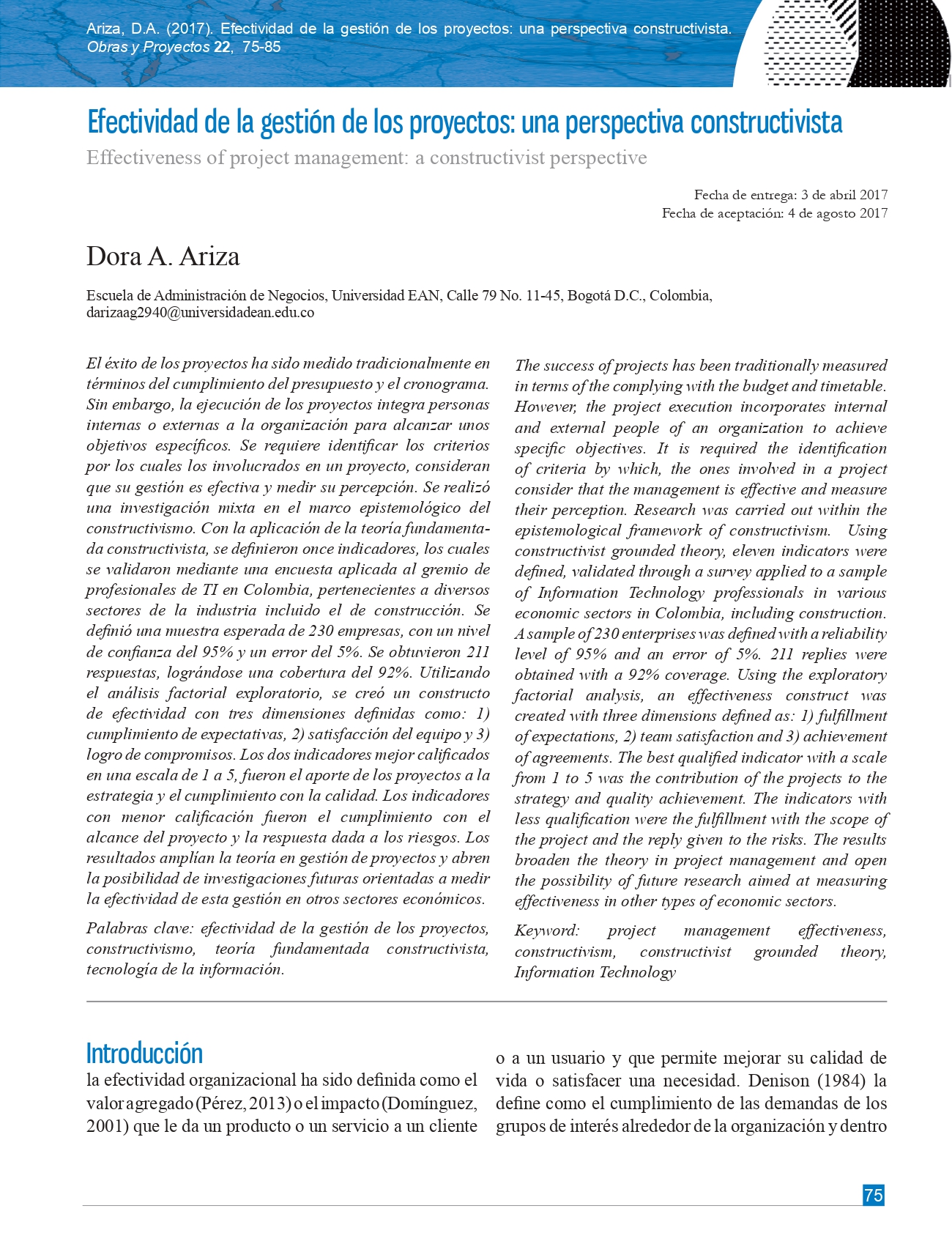
Effectiveness of project management: a constructivist perspective
DOI:
https://doi.org/10.4067/S0718-28132017000200075Keywords:
Project management effectiveness, Constructivism, Constructivist grounded theory, Information TechnologyAbstract
The success of projects has been traditionally measured in terms of the complying with the budget and timetable. However, the project execution incorporates internal and external people of an organization to achieve specific objectives. It is required the identification of criteria by which, the ones involved in a project consider that the management is effective and measure their perception. Research was carried out within the epistemological framework of constructivism. Using constructivist grounded theory, eleven indicators were defined, validated through a survey applied to a sample of Information Technology professionals in various economic sectors in Colombia, including construction. A sample of 230 enterprises was defined with a reliability level of 95% and an error of 5%. 211 replies were obtained with a 92% coverage. Using the exploratory factorial analysis, an effectiveness construct was created with three dimensions defined as: 1) fulfillment of expectations, 2) team satisfaction and 3) achievement of agreements. The best qualified indicator with a scale from 1 to 5 was the contribution of the projects to the strategy and quality achievement. The indicators with less qualification were the fulfillment with the scope of the project and the reply given to the risks. The results broaden the theory in project management and open the possibility of future research aimed at measuring effectiveness in other types of economic sectors.
References
ACIS (2014). X Encuesta de gerencia de proyectos. Asociación Colombiana de Ingenieros de Sistemas.
Astley, W.G. (1985). Administrative science as socially constructed truth. Administrative Science Quarterly 30 (4), 497-513.
Bartlett, M.S. (1950). Test of significance in factor analysis. British Journal of Mathematical and Statistical Psychology 3(2), 77-85.
Belout, A. (1998). Effects of human resource management on project effectiveness and success: toward a new conceptual work. International Journal of Project Management 16(1), 21-26.
Bryde, J.D. (2003). Modelling project management performance. The International Journal of Quality & Reliability Management 20(2), 229-254.
Chametzky, B. (2013). Generalizability and the theory of offsetting the affective filter. Grounded Theory Review 12 (2), 35-43.
Charmaz, K. (2008). Constructionism and the grounded theory method. Handbook of constructionist research. Holstein and Gubrium (eds.). The Guilford Press, New York, 397–412.
Charmaz, K. (2006). Constructing grounded theory: a practical guide through qualitative analysis. Sage Publications, London.
Cobern, W.W. (1993). Constructivism. Journal of Educational & Psychological Consultation 4(1), 105-113.
Cooke-Davies, T. (2002). The ‘‘real’’ success factors on projects. International Journal of Project Management 20(3), 185–190.
Denison, D.R. (1984). Bringing corporate culture to the bottom line. Organizational Dynamics 13 (2), 5-22.
De Wit, A. (1988). Measurement of project success. International Journal of Project Management 6(3), 164–170.
Din, S., Abd-Hamid, Z. and Bryde, D.J. (2011). ISO 9000 certification and construction project performance: The Malaysian experience. International Journal of Project Management 29(8), 1044-1056.
Domínguez, G. (2001). Indicadores de gestión. Un enfoque Sistémico. Bogotá: Biblioteca Jurídica Dike.
Fernandes, G., Ward, S., Araujo, M., Loureiro, I. and Braga, A. (2014). Perceptions of different stakeholders on improving and embedding project management practice in organisations. Procedia Technology 16, 957-966.
Fortune, J. and White, D. (2006). Framing of project critical success factors by a systems model. International Journal of Project Management 24, (1), 53-65.
Fosnot, C.T. (2005). Constructivism: theory, perspectives and practice. Teacher College Press, New York.
Glaser, B.G. and Strauss, A.L. (1967). The discovery of grounded theory: strategies for qualitative research. Aldine de Gruyter, New York.
Gregory, R.J. y Ruiz, V.O. (2001). Evaluación psicológica, historia, principios y aplicaciones. El Manual Moderno, México.
Heerkens, G.R. (2002). Project Management. McGraw-Hill.
Hussein, B.A and Klakegg, O.J. (2014). Measuring the impact of risk factors associated with project success criteria in early phase. Procedia - Social and Behavioral Sciences 119, 711 – 718.
Karlsen, J.T. (2011). Supportive culture for efficient project uncertainty management. International Journal of Managing Projects in Business 4(2), 240–256.
Kendra, K. and Taplin, L.J. (2004). Project success: a cultural framework. Project Management Journal 35(1), 30-45.
Kerzner, H. (2001). Strategic planning for project management using a project management maturity model. John Wiley & Sons.
Lawshe, C.H. (1975). A quantitative approach to content validity. Personnel Psychology 28(4), 563-575.
Lewis-Bech, M., Bryman, A. and Liao, T. (2003). The Sage Encyclopedia of Social Sciences Research Methods. Sage Publications.
Morrison, J. and Brown, C. (2004). Project management effectiveness as a construct: A conceptual study. South African Journal of Business Management 35(4), 73–94.
Mueller, J. (2014). A specific knowledge culture: cultural antecedents for knowledge sharing between project teams. European Management Journal 32(2), 190-202.
Ogbonna, E. and Harris, L.C. (2000). Leadership style, organizational culture and performance: Empirical evidence from UK companies. International Journal of Human Resource Management 11 (4), 766-788.
Oyegoke, A. (2011). The constructive research approach in project management research. International Journal of Managing Projects in Business 4(4), 573-596.
Pérez, R.I. (2013). Gerencia estratégica corporativa con aplicaciones para logística aeronáutica y gerencia de la seguridad aérea. Bogotá: Fuerza Aérea Colombiana, Instituto Militar Aeronáutico.
Quinn, R.E. and Rohrbaugh, J. (1983). A spatial model of effectiveness criteria: towards a competing values approach to organizational analysis. Management Science 29(3), 363-377.
Qureshi, T.M., Warraich, A.S. and Hijazi, S.T. (2009). Significance of project management performance assessment (PMPA) model. International Journal of Project Management 27(4), 378-388.
Royal Academy of Engineering (2009). Engineering values in IT. http://www.raeng.org.uk/engineeringIT
SGI (2014). Value versus success & the orthogonals. Chaos Manifesto 2014. Project smart. Standish Group International.
Shenhar, A.J., Dvir, D., Levy, O. and Maltz, A.C. (2001). Project success: A multidimensional strategic concept. Long Range Planning 34 (6), 699-725.
Smyth, H.J. and Morris, P.W. (2007). An epistemological evaluation of research into projects and their management: methodological issues. International Journal of Project Management 25(4), 423-36.
Stare, A. (2012). The impact of a project organizational culture and team rewarding on project performance. Journal for East European Management Studies 17 (1), 40-67.
Strauss, A.L. and Corbin, J. (1998). Basics of qualitative research techniques and procedures for developing grounded theory. SAGE Publications, London.
Teller, J. (2013). Portfolio risk management and its contribution to project portfolio success: an investigation of organization, proccess, and culture. Project Management Journal 44 (2), 36-51.
Thornberg, R. (2012). Informed grounded theory. Scandinavian Journal of Educational Research 56(3), 243–259.
Tristán-López, A. (2008). Modificación al modelo de Lawshe para el dictamen cuantitativo de la validez de contenido de un instrumento objetivo. Avances en Medición 6(1), 37–48.
Westerveld, E. (2003). The Project Excellence Model®: linking success criteria and critical success factors. International Journal of Project Management 21(6), 411-418.
Downloads
Published
Issue
Section
License
Copyright (c) 2017 Universidad Católica de la Santísima Concepción

This work is licensed under a Creative Commons Attribution-NonCommercial 4.0 International License.