Probabilistic evaluation of sands liquefaction in Piura city in Peru
DOI:
https://doi.org/10.4067/S0718-28132017000200061Keywords:
Liquefaction probability, Taylor’s series, Monte Carlo simulationsAbstract
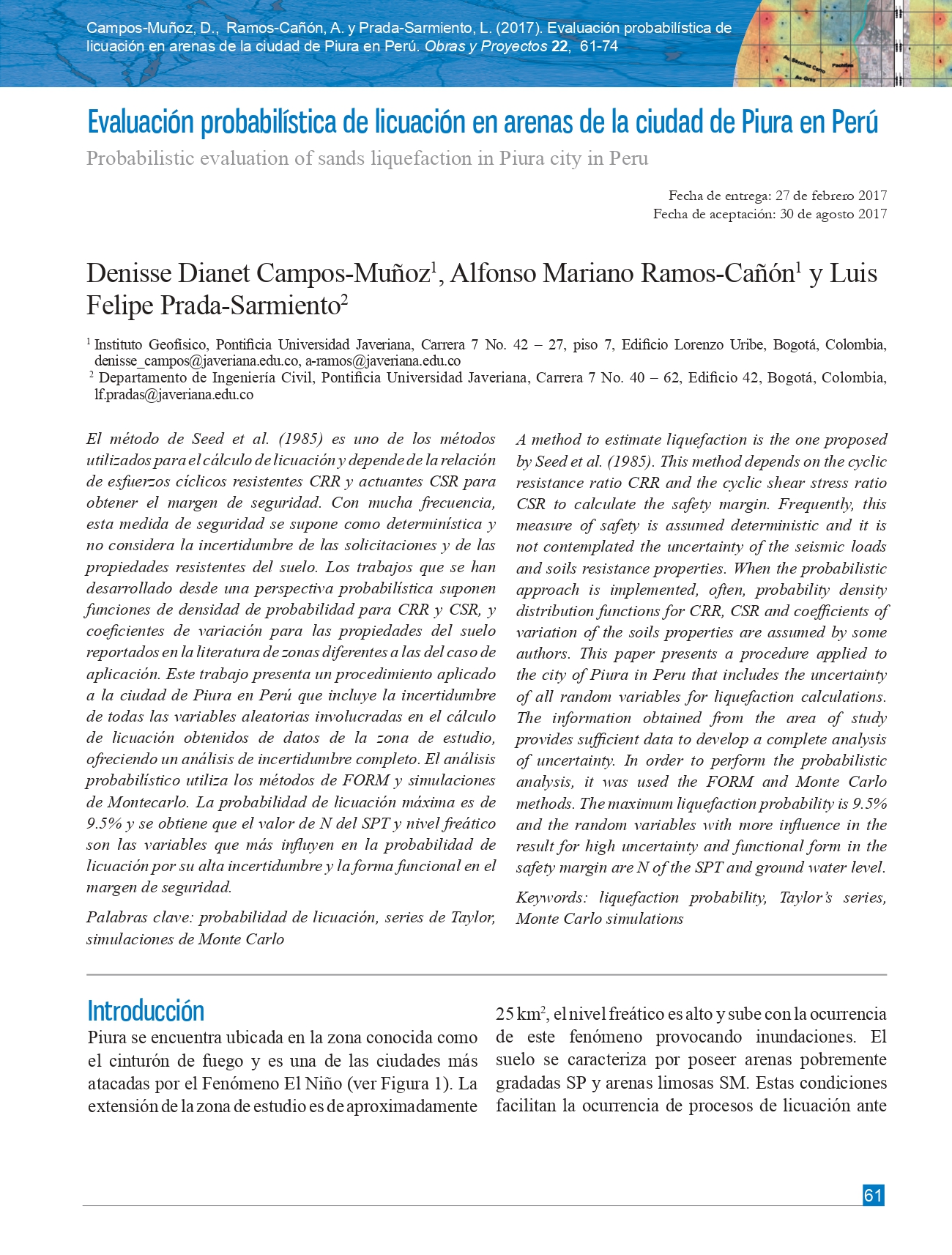
A method to estimate liquefaction is the one proposed by Seed et al. (1985). This method depends on the cyclic resistance ratio CRR and the cyclic shear stress ratio CSR to calculate the safety margin. Frequently, this measure of safety is assumed deterministic and it is not contemplated the uncertainty of the seismic loads and soils resistance properties. When the probabilistic approach is implemented, often, probability density distribution functions for CRR, CSR and coefficients of variation of the soils properties are assumed by some authors. This paper presents a procedure applied to the city of Piura in Peru that includes the uncertainty of all random variables for liquefaction calculations. The information obtained from the area of study provides sufficient data to develop a complete analysis of uncertainty. In order to perform the probabilistic analysis, it was used the FORM and Monte Carlo methods. The maximum liquefaction probability is 9.5% and the random variables with more influence in the result for high uncertainty and functional form in the safety margin are N of the SPT and ground water level.
References
Andrus, R.D. and Stokoe II, K.H. (2000). Liquefaction resistance of soils from shear-wave velocity. Journal of Geotechnical and Geoenvironmental Engineering 126(11), 1015-1025.
Arévalo, G., Ramos-Cañón, A. y Prada, L. (2014). Análisis de confiabilidad en un modelo de descarga de silos de almacenamiento mediante el Método de Elementos Discretos DEM. Obras y Proyectos 15, 21-30.
Ascencio Saavedra, F. (2012). Aplicación del SIG como herramienta para la prevención de riesgos geotécnicos en la ciudad de Piura. Tesis de grado, Universidad de Piura.
Baecher, G.B. and Christian, J.T. (2003). Reliability and statistics in geotechnical engineering. John Wiley & Sons.
Boulanger, R.W. and Idriss, I.M. (2012). Probabilistic standard penetration test–based liquefaction–triggering procedure. Journal of Geotechnical and Geoenvironmental Engineering 138(10), 1185-1195.
Campos Muñoz, D.D. (2011). Estudio de la variabilidad del suelo de Piura a través del SPT para la valoración del FS. Tesis de grado, Universidad de Piura.
Eurocode (2005). Design of Steel Structures, Part 1-1; General Rules and Rules for Buildings. European Committee for Standardization, Brussels.
EHE (1998). Instrucción de hormigón estructural. Ministerio de Fomento, Madrid.
Gamarra Rivera, C.A. (2009). Nuevas fuentes sismogénicas para la evaluación del peligro sísmico y generación de espectros de peligro uniforme en el Perú. Universidad Nacional de Ingeniería, Perú.
Gutierrez, M. Duncan, J.M., Woods, C. and Eddy, E. (2003). Development of a simplified reliability–based method for liquefaction evaluation. Report USGS Grant N° 02HQGR0058, Virginia Polytechnic Institute and State University.
Harr, M.E. (1984). Reliability-based design in civil engineering. Henry Shaw Lecture, Department of Civil Engineering, North Carolina State University, Raleigh.
Hidalgo Montoya, C.A. y Pacheco de Assis, A. (2011). Herramientas para análisis por confiabilidad en geotecnia: La teoría. Revista Ingenierías Universidad de Medellín 10(18), 69-78.
Hurtado, E.A. (2011). Breve historia del fenómeno de licuación de suelos en el Perú. Centro Peruano Japonés de Investigaciones Sísmicas y Mitigación de Desastres CISMID. Guzlop Editoras, Lima.
Hwang, J.H., Yang, C.W. and Juang, D.S. (2004). A practical reliability – based method for assessing soil liquefaction potential. Soil Dynamics and Earthquake Engineering 24(9), 761-770.
Idriss, I.M. and Boulanger, R.W. (2006). Semi-empirical procedures for evaluating liquefaction potential during earthquakes. Soil Dynamics and Earthquake Engineering 26(2), 115-130.
Jha, S. and Suzuki, K. (2008). Reliability analysis of soil liquefaction based on standard penetration test. Computers and Geotechnics 36(4), 589–596.
Jones, A.L., Kramer, S. L. and Arduino, P. (2002). Estimation of uncertainty in geotechnical properties for performanced-based earthquake engineering. California: Pacific Earthquake Engineering Research Center.
Juang, C.H., Liang, T. and Andrus, R.D. (2002). Assessing probability–based methods for liquefaction potential evaluation. Journal of Geotechnical and Geoenviromental Engineering 128(7), 580-589.
Juang C.H., Rosowsky D.V. and Tang W.H. (1999). Reliability - based method for assessing liquefaction potential of soils. Journal of Geotechnical and Geoenviromental Engineering 125(8), 684-689.
Kulhawy, F.H. and Trautmann, C.H. (1996). Estimation of in-situ test uncertainty. Conference on Uncertainty in the Geologic Environment: from theory to practice, ASCE GSP, Madison, 269–286.
Liao, S.S. and Whitman, R.V. (1986). Overburden correction factors for SPT in sand. Journal of Geotechnical Engineering 112(3), 373-377.
Menezes, S.M., de Carvalho, D. and da Rocha de Albuquerque, P.J. (2006). Analysis of uplift loads of precastconcrete piles in porous soils. Exacta 4 (1), 191-200.
MVCS (2006). Reglamento Nacional de Edificaciones E.050 Suelos y Cimentaciones. Ministerio de Vivienda, Construcción y Saneamiento, Perú.
NASEM (2016). State of the art and practice in the assessment of earthquake-induced soil liquefaction and its consequences. The National Academies of Sciences, Engineering, and Medicine. The National Academies Press, Washington, DC.
NSR (2010). Normas Colombianas de Diseño y Construcción Sismo Resistente. Asociación Colombiana de Ingeniería Sísmica, Bogotá, Colombia.
Pinto Zegarra, C. F. (1998). Identificación de zonas con potencial de licuación de suelos en la ciudad de Piura con ensayos SPT. Tesis de grado, Universidad de Piura.
Prada, L., Ramos, A., Solaque, B. y Caicedo, B. (2011). Confiabilidad aplicada al diseño geotécnico de un muro de contención. Obras y Proyectos 9, 49-58.
Puga, P.E. (2012). Estudio experimental del coeficiente de permeabilidad en arenas. Proyecto de título, Universidad Católica de la Santísima Concepción, Chile.
Robertson, P.K. and Wride, C. E. (1998). Evaluating cyclic liquefaction potential using the cone penetration test. Canadian Geotechnical Journal 35(3), 442-459.
ROM (2005). Recomendaciones geotécnicas para obras marítimas y portuarias ROM 0.5-05. Puertos del Estado, España.
Seed, H.B. and Idriss, I.M. (1971). Simplified procedure for evaluating soil liquefaction potential. Journal of Soil Mechanics and Foundations Division 97(9), 1249-1273.
Seed, H.B., Tokimatsu, K., Harder, L.F. and Chung, R.M. (1985). Influence of SPT procedures in soil liquefaction resistance evaluations. Journal of Geotechnical Engineering 111(12), 1425-1445.
SGC (2015). Guía metodológica para estudios de amenaza, vulnerabilidad y riesgo por movimientos en masa. Servicio Geológico Colombiano, Bogotá.
Silgado Ferro, E. (1978). Historia de los sismos más notables ocurridos en el Perú (1513-1974). Instituto Geológico Minero y Metalúrgico INGEMMET. Guzlop Editoras, Lima.
Yanez, D.G., Massad, F. and Correa, M.R. (2015). Soft soil geotechnical properties in a case study of a large alluvial soft soil improvement in Latin America. 15th Congreso Panamericano de Mecánica de Suelos e Ingeniería Geotécnica, IOS Press, Buenos Aires, 1599-1606.
Youd, T.L., Idriss, I.M., Andrus, R.D., Arango, I., Castro, G., Christian, J.T., Dobry, R., Liam Finn, W.D., Harder, L.F., Hynes, M.E., Ishihara, K., Koester, J.P., Liao, S., Marcuson III, W.F., Martin, G.R., Mitchell, J.K., Moriwaki, Y., Power, M.S., Robertson, P.K., Seed, R.B., Stokoe II, K.H. (2001). Liquefaction resistance of soils: summary report from the 1996 NCEER and 1998 NCEER/ NSF workshops on evaluation of liquefaction resistance of soils. Journal of Geotechnical and Geoenvironmental Engineering 127(10), 817-833.
Downloads
Published
Issue
Section
License
Copyright (c) 2017 Universidad Católica de la Santísima Concepción

This work is licensed under a Creative Commons Attribution-NonCommercial 4.0 International License.