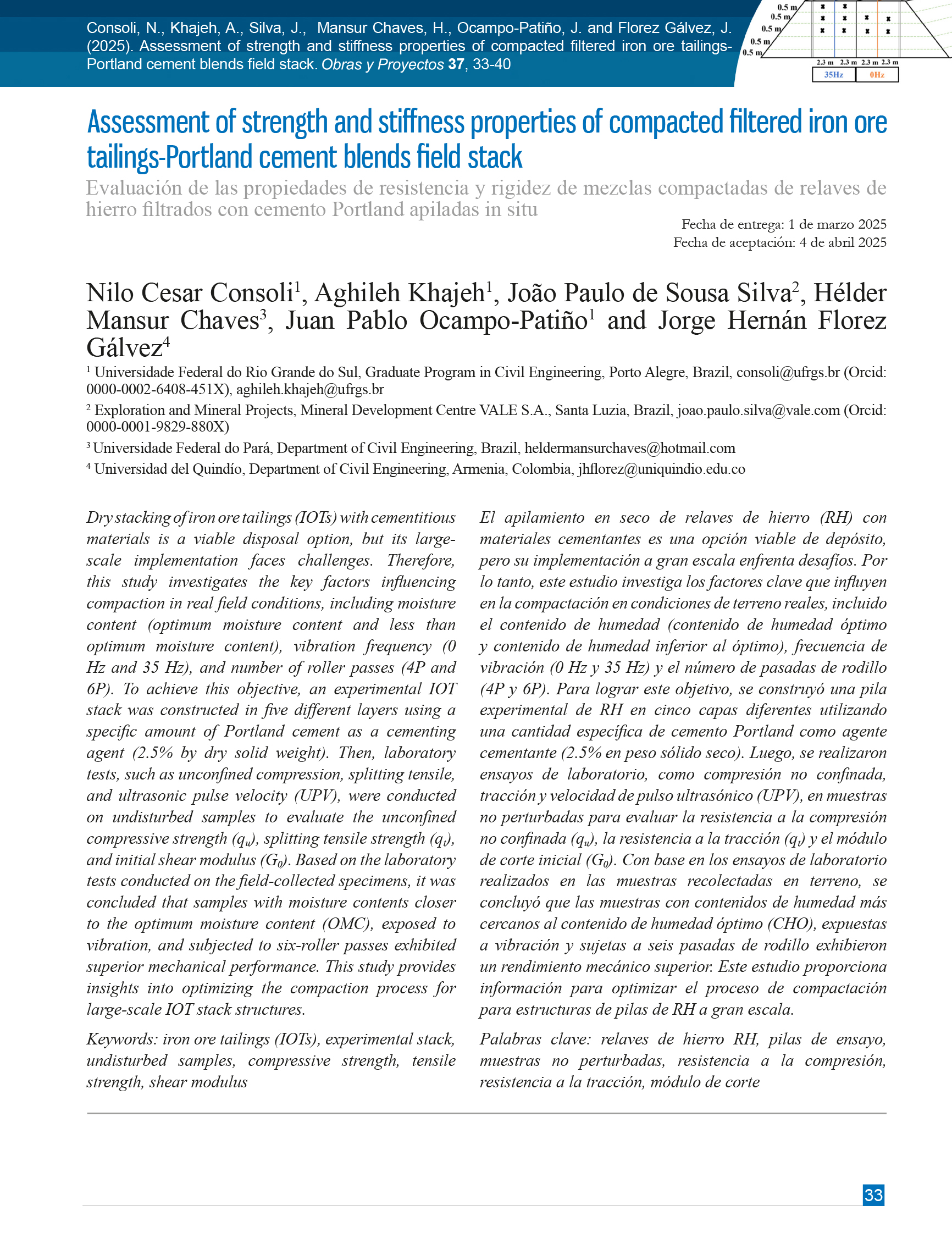
Assessment of strength and stiffness properties of compacted filtered iron ore tailings-Portland cement blends field stack
DOI:
https://doi.org/10.21703/0718-2813.2025.37.3234Keywords:
Iron ore tailings (IOTs), Experimental stack, Undisturbed samples, Compressive strength, Tensile strength, Shear modulusAbstract
Dry stacking of iron ore tailings (IOTs) with cementitious materials is a viable disposal option, but its largescale implementation faces challenges. Therefore, this study investigates the key factors influencing compaction in real field conditions, including moisture content (optimum moisture content and less than optimum moisture content), vibration frequency (0 Hz and 35 Hz), and number of roller passes (4P and 6P). To achieve this objective, an experimental IOT stack was constructed in five different layers using a specific amount of Portland cement as a cementing agent (2.5% by dry solid weight). Then, laboratory tests, such as unconfined compression, splitting tensile, and ultrasonic pulse velocity (UPV), were conducted on undisturbed samples to evaluate the unconfined compressive strength (qu), splitting tensile strength (qt), and initial shear modulus (G0). Based on the laboratory tests conducted on the field-collected specimens, it was concluded that samples with moisture contents closer to the optimum moisture content (OMC), exposed to vibration, and subjected to six-roller passes exhibited superior mechanical performance. This study provides insights into optimizing the compaction process for large-scale IOT stack structures.
References
Amoah, N., Dressel, W. and Fourie, A. (2018). Characterisation of unsaturated geotechnical properties of filtered magnetite tailings in a dry stack facility. 21st International Seminar on Paste and Thickened Tailings, Paste 2018, Perth, Australia, 375–388. https://doi.org/10.36487/ACG_rep/1805_31_Amoah.
ASTM C150 (2022). Standard specification for Portland cement. ASTM International, West Conshohocken, PA, USA.
ASTM C496/C496M (2017). Standard test method for splitting tensile strength of cylindrical concrete specimens. ASTM International, West Conshohocken, PA, USA.
ASTM D854 (2014). Standard test methods for specific gravity of soil solids by water pycnometer. ASTM International, West Conshohocken, PA, USA.
ASTM D2166 (2006). Standard test method of unconfined compressive strength of cohesive soil. ASTM International. West Conshohocken, PA, USA.
ASTM D2216 (2019). Test methods for laboratory determination of water (moisture) content of soil and rock by mass. ASTM International, West Conshohocken, PA, USA.
ASTM D2487 (2011). Standard practice for classification of soils for engineering purposes (Unified Soil Classification System). ASTM International, West Conshohocken, PA.
ASTM D4318 (2010). Standard test methods for liquid limit, plastic limit, and plasticity index of soils. ASTM International, Conshohocken, PA, USA.
ASTM D4643 (2017). Test method for determination of water (moisture) content of soil by microwave oven heating. ASTM International, Conshohocken, PA, USA.
ASTM D7928 (2017). Standard test method for particlesize distribution (gradation) of fine-grained soils using the sedimentation (hydrometer) analysis. ASTM International, Conshohocken, PA, USA.
Bastos, L.A. de C., Silva, G.C., Mendes, J.C. and Peixoto, R.A. F. (2016). Using iron ore tailings from tailing dams as road material. Journal of Materials in Civil Engineering 28(10), 04016102. https://doi.org/10.1061/(ASCE)MT.1943-5533.0001613
Bittar Marin, E.J., Quiñónez Samaniego, R.A., Tebechrani Neto, A. and Consoli, N.C. (2023). Cement stabilized soil field samples: quality control for bases and sub-bases. Geotechnical and Geological Engineering 41(7), 4169–4184. https://doi.org/10.1007/s10706-023-02514-5
Carvalho, J.V. de A., Wagner, A.C., Scheuermann Filho, H.C., Chaves, H.M., Silva, J.P.S., Delgado, B.G. and Consoli, N.C. (2023). Evaluation of strength parameters for application in cemented iron ore tailings stacks. Indian Geotechnical Journal 53(4), 775–788. https://doi.org/10.1007/s40098-023-00712-9
Consoli, N.C., Foppa, D., Festugato, L. and Heineck, K.S. (2007). Key parameters for strength control of artificially cemented soils. Journal of Geotechnical and Geoenvironmental Engineering 133(2), 197–205. https://doi.org/10.1061/(ASCE)1090-0241(2007)133:2(197)
Consoli, N.C., Vogt, J.C., Silva, J.P.S., Chaves, H.M., Scheuermann Filho, H.C., Moreira, E.B. and Lotero, A. (2022). Behaviour of compacted filtered iron ore tailings–Portland cement blends: New Brazilian trend for tailings disposal by stacking. Applied Sciences 12(2), 836. https://doi.org/10.3390/app12020836
Cox, B., Innis, S., Steen, J. and Kunz, N. (2023). The environmental and economic case for valuing water recovery and its relationship with tailings storage conservation. Minerals Engineering 201, 108157. https://doi.org/10.1016/j.mineng.2023.108157
Davies, M. (2011). Filtered dry stacked tailings : the fundamentals. Tailings and Mine Waste Conference, Vancouver, BC, Canada. https://doi.org/10.14288/1.0107683
Djellali, A., Laouar, M.S., Saghafi, B. and Houam, A. (2019). Evaluation of cement-stabilized mine tailings as pavement foundation materials. Geotechnical and Geological Engineering 37(4), 2811–2822. https://doi.org/10.1007/s10706-018-00796-8
Doi, A., Nguyen, T.A.H., Nguyen, N.N., Nguyen, C.V., Raji, F. and Nguyen, A.V. (2023). Enhancing shear strength and handleability of dewatered clay-rich coal tailings for drystacking. Journal of Environmental Management 344, 118488. https://doi.org/10.1016/j.jenvman.2023.118488
dos Santos, C.P., Bruschi, G.J., Mattos, J.R.G. and Consoli, N.C. (2022). Stabilization of gold mining tailings with alkali-activated carbide lime and sugarcane bagasse ash. Transportation Geotechnics 32, 100704. https://doi.org/10.1016/j.trgeo.2021.100704
Edraki, M., Baumgartl, T., Manlapig, E., Bradshaw, D., Franks, D.M. and Moran, C.J. (2014). Designing mine tailings for better environmental, social and economic outcomes: a review of alternative approaches. Journal of Cleaner Production 84(1), 411–420. https://doi.org/10.1016/j.jclepro.2014.04.079
Gomes, R.B., De Tomi, G. and Assis, P.S. (2016). Iron ore tailings dry stacking in Pau Branco mine, Brazil. Journal of Materials Research and Technology 5(4), 339–344. https://doi.org/10.1016/j.jmrt.2016.03.008
Huang, X., Ranade, R. and Li, V.C. (2013). Feasibility study of developing green ECC using iron ore tailings powder as cement replacement. Journal of Materials in Civil Engineering 25(7), 923–931. https://doi.org/10.1061/(ASCE)MT.1943-5533.0000674
Kossoff, D., Dubbin, W.E., Alfredsson, M., Edwards, S.J., Macklin, M.G., and Hudson-Edwards, K.A. (2014). Mine tailings dams: Characteristics, failure, environmental impacts, and remediation. Applied Geochemistry 51, 229–245. https://doi.org/10.1016/j.apgeochem.2014.09.010
Li, Q., Wu, B.Z., Li, X., Jia, S., Zhen, F.H. and Gao, S. (2022). The relatively stable seepage field: A new concept to determine seepage field in the design of a dry-stack tailings pond. Applied Sciences 12 (23), 12123, https://doi.org/10.3390/app122312123
Mafessoli, M., Marques, S.F.V., Scheuermann Filho, H.C. and Consoli, N.C. (2023). Response of artificially cemented iron ore tailings for dry stacking disposal over a wide range of stresses. Indian Geotechnical Journal 53(4), 904–915. https://doi.org/10.1007/s40098-023-00711-w
NBR 7182 (2020). Compaction test. Associação Brasileira de Normas Técnicas, Sao Paulo, Brazil.
Osinubi, K.J., Yohanna, P. and Eberemu, A.O. (2015). Cement modification of tropical black clay using iron ore tailings as admixture. Transportation Geotechnics 5, 35–49. https://doi.org/10.1016/j.trgeo.2015.10.001
Rima, U.S. and Beier, N.A. (2022). Effects of seasonal weathering on dewatering and strength of an oil sands tailings deposit. Canadian Geotechnical Journal 59(3), 447–457. https://doi.org/10.1139/cgj-2020-0533
Schatzmayr Welp Sá, T., Oda, S., Balthar, V.K. and Toledo Filho, R. (2022). Use of iron ore tailings and sediments on pavement structure. Construction and Building Materials, 342, 128072. https://doi.org/10.1016/j.conbuildmat.2022.128072
Servi, S., Lotero, A., Silva, J.P.S., Bastos, C. and Consoli, N.C. (2022). Mechanical response of filtered and compacted iron ore tailings with different cementing agents: focus on tailings-binder mixtures disposal by stacking. Construction and Building Materials 349, 128770. https://doi.org/10.1016/j.conbuildmat.2022.128770
Wagner, A.C., Carvalho, J.V., Silva, J.P.S, Scheuermann Filho, H.C., and Consoli, N.C. (2023). Dry stacking of iron ore tailings: possible particle breakage during compaction. Geotechnical Engineering 177(6), 779-787, https://doi.org/10.1680/jgeen.22.00216
Wei, Z., Yin, G., Wang, J.G., Wan, L. and Li, G. (2013). Design, construction and management of tailings storage facilities for surface disposal in China: Case studies of failures. Waste Management & Research 31(1), 106-112, https://doi.org/10.1177/0734242X12462281
Xu, W., Tian, M. and Li, Q. (2020). Time-dependent rheological properties and mechanical performance of fresh cemented tailings backfill containing flocculants. Minerals Engineering 145, 106064. https://doi.org/10.1016/j.mineng.2019.106064
Downloads
Published
Issue
Section
License
Copyright (c) 2025 Universidad Católica de la Santísima Concepción

This work is licensed under a Creative Commons Attribution-NonCommercial 4.0 International License.