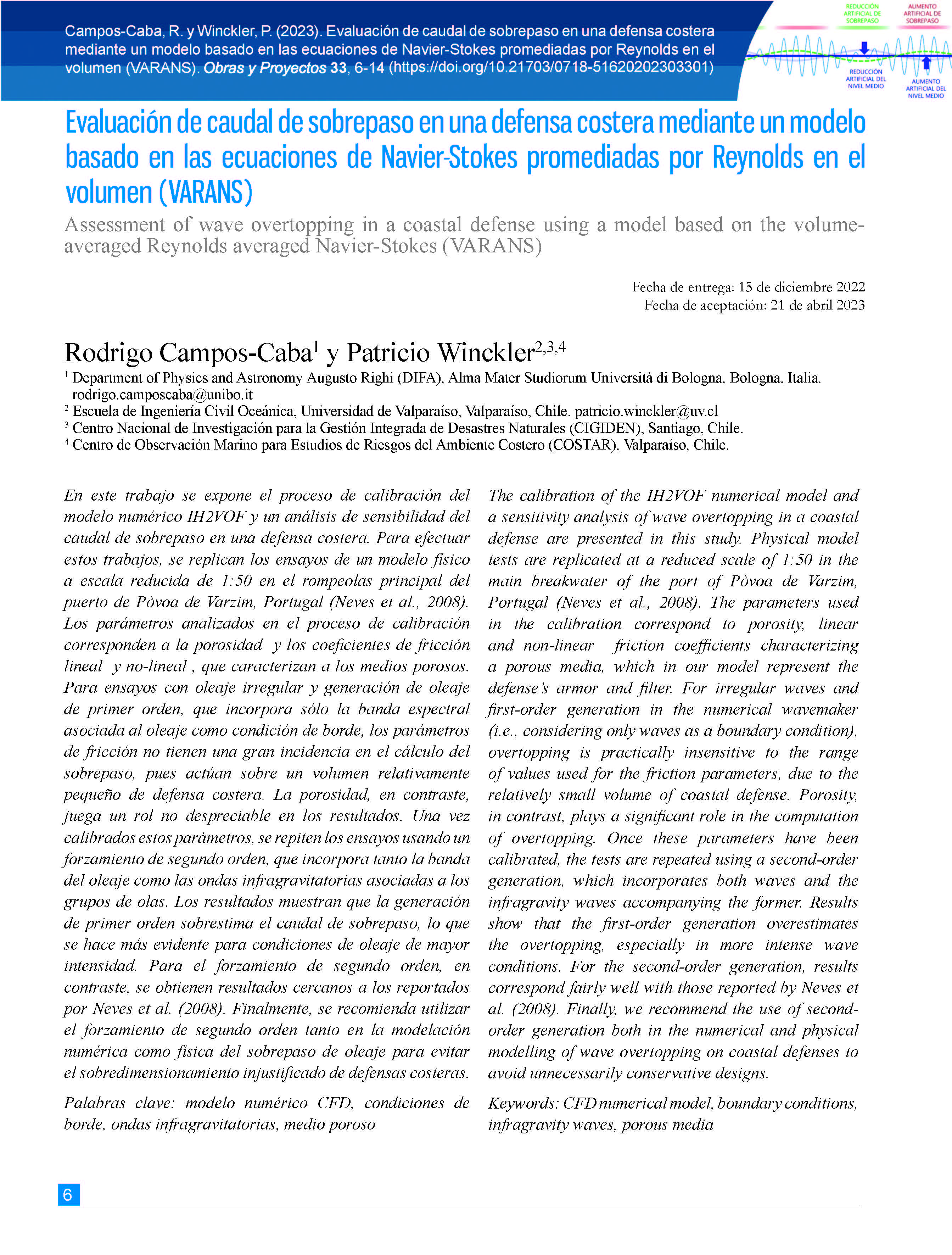
Assessment of wave overtopping in a coastal defense using a model based on the volume-averaged Reynolds averaged Navier-Stokes (VARANS)
DOI:
https://doi.org/10.21703/0718-281320233301Keywords:
CFD numerical model, Boundary conditions, Infragravity waves, Porous mediaAbstract
The calibration of the IH2VOF numerical model and a sensitivity analysis of wave overtopping in a coastal defense are presented in this study. Physical model tests are replicated at a reduced scale of 1:50 in the main breakwater of the port of Pòvoa de Varzim, Portugal (Neves et al., 2008). The parameters used in the calibration correspond to porosity, linear and non-linear friction coefficients characterizing a porous media, which in our model represent the defense’s armor and filter. For irregular waves and first-order generation in the numerical wavemaker (i.e., considering only waves as a boundary condition), overtopping is practically insensitive to the range of values used for the friction parameters, due to the relatively small volume of coastal defense. Porosity, in contrast, plays a significant role in the computation of overtopping. Once these parameters have been calibrated, the tests are repeated using a second-order generation, which incorporates both waves and the infragravity waves accompanying the former. Results show that the first-order generation overestimates the overtopping, especially in more intense wave conditions. For the second-order generation, results correspond fairly well with those reported by Neves et al. (2008). Finally, we recommend the use of secondorder generation both in the numerical and physical modelling of wave overtopping on coastal defenses to avoid unnecessarily conservative designs.
References
Allsop, N.W.H., Bruce, T., De Rouck, J., Kortenhaus, A., Pullen, T., Schüttrumpf, H., Troch, P. and Zanuttigh, B. (2016). EurOtop II Manual on wave overtopping of sea defences and related structures: An overtopping manual largely based on European research, but for worldwide application. Second edition. HR Wallingford, UK.
Beyá, I. (2017). Comparación del sobrepaso del oleaje en canales experimentales, utilizando teorías de generación de oleaje de 1er y 2do orden. Caso de análisis: Av. Perú, Viña del Mar, Chile, en canal bidimensional del Instituto Nacional de Hidráulica. XXIII Congreso Chileno de Ingeniería Hidráulica, Universidad Santa María, Valparaíso, Chile, artículo 52.
Di Lauro, E., Lara, J.L., Maza, M., Losada, I.J., Contestabile, P. and Vicinanza, D. (2019). Stability analysis of a nonconventional breakwater for wave energy conversion. Coastal Engineering 145, 36-52.
Fritz, S. (2018). Estudio del sobrepaso en avenida Perú mediante el software CFD - olaFOAM. Memoria del proyecto para optar al Título de Ingeniero Civil Oceánico. Universidad de Valparaíso, Chile.
García, N., Lara, J.L. and Losada, I.J. (2004). 2D numerical analysis of near-field flow at low-crested permeable breakwaters. Coastal Engineering 51(10), 991-1020.
Guanche, R., Losada, I.J. and Lara, J.L. (2009). Numerical modelling of coastal structures stability. Coastal Engineering 56(5-6), 543-558.
Lara, J.L. (2005). A numerical wave flume to study the functionality and stability of coastal structures. Journal of the International Navigation Association (PIANC) 121: 5-29.
Lara, J.L., Garcia, N. and Losada, I.J. (2006). RANS modelling applied to random wave interaction with submerged permeable structures. Coastal Engineering 53(5-6), 395-417.
Losada I.J., Lara J.L., Christensen E.D. and Garcia, N. (2005). Modelling of velocity and turbulence fields around and within low-crested rubble-mound breakwaters. Coastal Engineering 52(10-11), 887-913.
Losada, I.J., Lara, J.L., Guanche, R. and Gonzalez-Ondina, J.M. (2008). Numerical analysis of wave overtopping of rubble mound breakwaters. Coastal Engineering 55(1), 47-62.
Neves, M.G., Reis, M.T., Losada, I.J., Asce, M., Keming, H. (2008). Wave overtopping of Póvoa de Varzim breakwater: physical and numerical simulations. Journal of Waterways, Port, Coastal and Ocean Engineering 134(4), 226-236.
Pedersen, J. (1996). Wave forces and overtopping on crown walls of rubble mound breakwaters: an experimental study. Aalborg Universitetsforlag. Series paper No. 12, Denmark.
USACE (2011). Coastal engineering manual, part VI, chapter 5: Fundamentals of design. US Army Corps of Engineers. USA.
Winckler, P., Contreras-López, M., Campos-Caba, R., Beya, J. y Molina, M. (2017). El temporal del 8 de agosto de 2015 en las regiones de Valparaíso y Coquimbo, Chile Central. Latin American Journal of Aquatic Research 45(4): 622-648.
Winckler, P., Esparza, C., Agredano, R. y Ibaceta, R. (2019). Nuevas metodologías para el estudio de marejadas en Chile. En Martínez, C., Hidalgo, R., Henríquez, C., Arenas, F., Rangel, N. y Contreras-López, M. (eds.). La Zona Costera en Chile: Adaptación y Planificación para la Resiliencia. Serie GEOlibro Nº 31, Instituto de Geografía, Pontificia Universidad Católica de Chile, Santiago, Chile.
Downloads
Published
Issue
Section
License

This work is licensed under a Creative Commons Attribution-NonCommercial 4.0 International License.