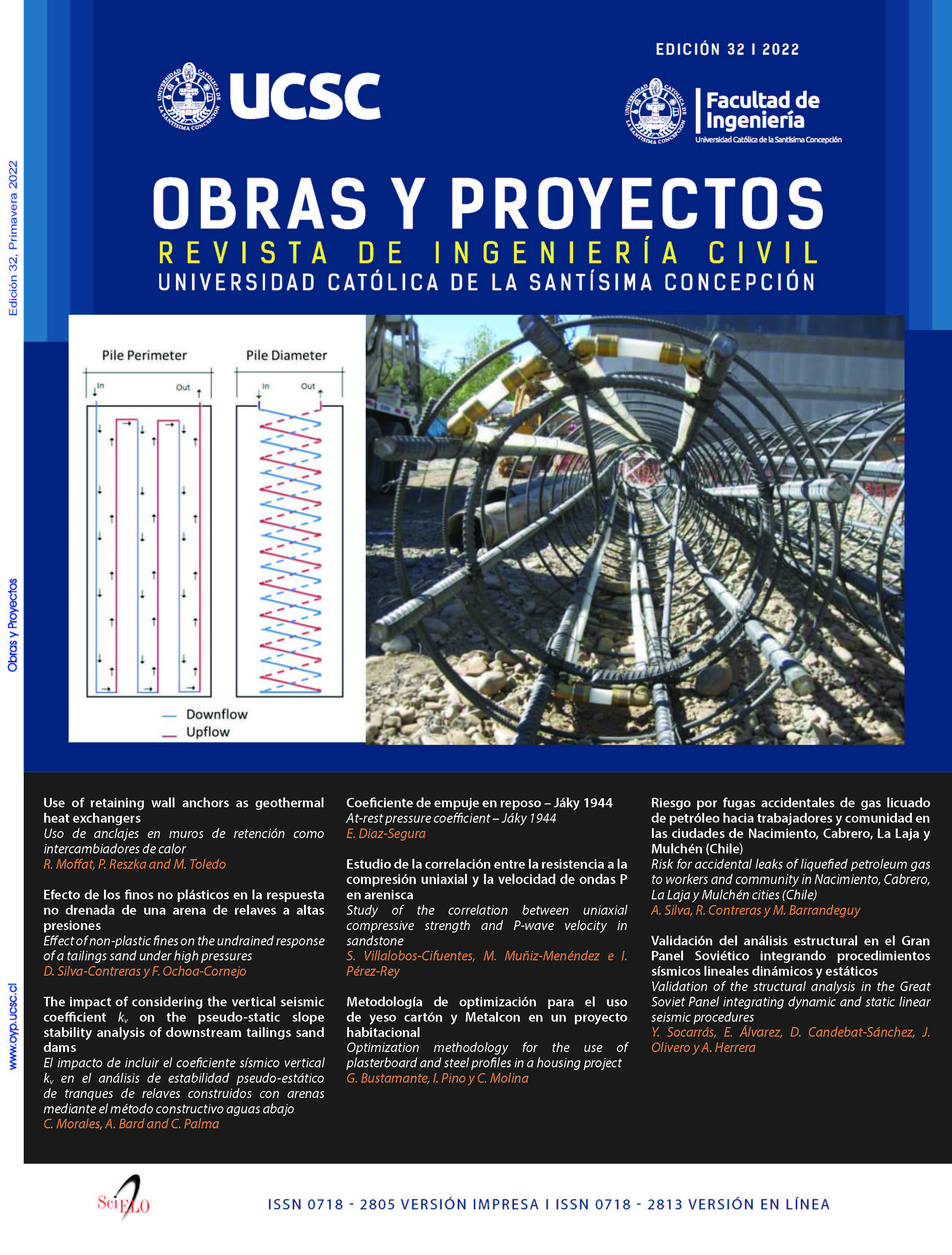
Optimization methodology for the use of plasterboard and steel profiles in a housing project
DOI:
https://doi.org/10.21703/0718-51620202203206Keywords:
Optimization, Construction waste, Plasterboard, Metalcon galvanized steel profilesAbstract
Currently in construction is where most waste is produced worldwide, generating around 35% of solid waste in the world and a similar percentage in Chile. For every square metre built, 0.26 m3 of waste is produced, approximately in the construction stage. In the present investigation, the construction work was analysed in the San Andrés del Valle extension by Aitue construction company located in Concepción city, Bío Bío region, Chile. What it is looking for is to develop a proposal to minimize the loss of materials, specifically two of the most used elements in the construction of houses, such as plasterboard and galvanized steel profiles. In this way, the aforementioned materials can be optimized, reducing the quantity of residues and therefore, have a cleaner work. In addition, an economic analysis of the savings generated as a result of an on-site optimization of the materials under study is carried out.
References
Aleksanin, A. (2019). Development of construction waste management. XXII International Scientific Conference on Construction for the Formation of Living Environment FORM2019, E3S Web of Conferences 97, 06040.
Bravo, J., Valderrama, C. y Ossio, F. (2019). Cuantificación económica de los residuos de construcción de una edificación en altura: un caso de estudio. Información Tecnológica 30(2), 85-94.
Bravo J. (2018). Análisis de las principales pérdidas de materiales en obras de edificación en etapa de terminaciones. Memoria de título de Constructor Civil, Universidad Técnica Federico Santa María, Valparaíso, Chile.
Chandrakanthi, M., Hettiaratchi, P., Prado, B. and Ruwanpura, J.Y. (2002). Optimization of the waste management for construction projects using simulation. IEEE Winter Simulation Conference, vol. 2, 1771-1777.
CutMaster 2D (2015). Cutting optimization software for professional and home workshops. Pro v.1.5.3. Greensburg PA, USA.
Ghaffar, S.H., Burman, M. and Braimah, N. (2020). Pathways to circular construction: an integrated management of construction and demolition waste for resource recovery. Journal of Cleaner Production 244, 118710.
Guarda J. (2008). Estudio para minimizar las pérdidas de materiales en obras de edificación en extensión. Memoria de título de Ingeniero Civil, Universidad de Chile, Santiago, Chile.
MMA (2020). Generación residuos de la construcción y demolición, Capítulo 2.6. Residuos, Capítulo 10. Informe del estado del medio ambiente. Ministerio del Medio Ambiente MMA, Santiago, Chile.
MINVU (2018). Estándares de construcción sustentable para viviendas de Chile. Tomo IV: Materiales y Residuos. Ministerio de Vivienda y Urbanismo, Santiago, Chile.
Pape, H. y Nazer, A. (2021). Determinantes de la innovación en empresas constructoras de la Región de Atacama, Chile. Obras y Proyectos 29, 80-92.
Patel, S. and Patel, C.G. (2016). Cost optimization of the project by construction waste management. International Research Journal of Engineering and Technology 3(5), 734-740.
SketchUp (2017). 3D design software. v.16.1.1450. Trimble Inc., Sunnyvale CA, USA.
Véliz, K.D., Ramírez-Rodríguez, G. and Ossio, F. (2022). Willingness to pay for construction and demolition waste from buildings in Chile. Waste Management 137, 222-230.
Wang, J., Wu, H., Tam, V.W. and Zuo, J. (2019). Considering life-cycle environmental impacts and society’s willingness for optimizing construction and demolition waste management fee: An empirical study of China. Journal of Cleaner Production 206, 1004-1014.
Downloads
Published
Issue
Section
License
Copyright (c) 2022 Universidad Católica de la Santísima Concepción

This work is licensed under a Creative Commons Attribution-NonCommercial 4.0 International License.