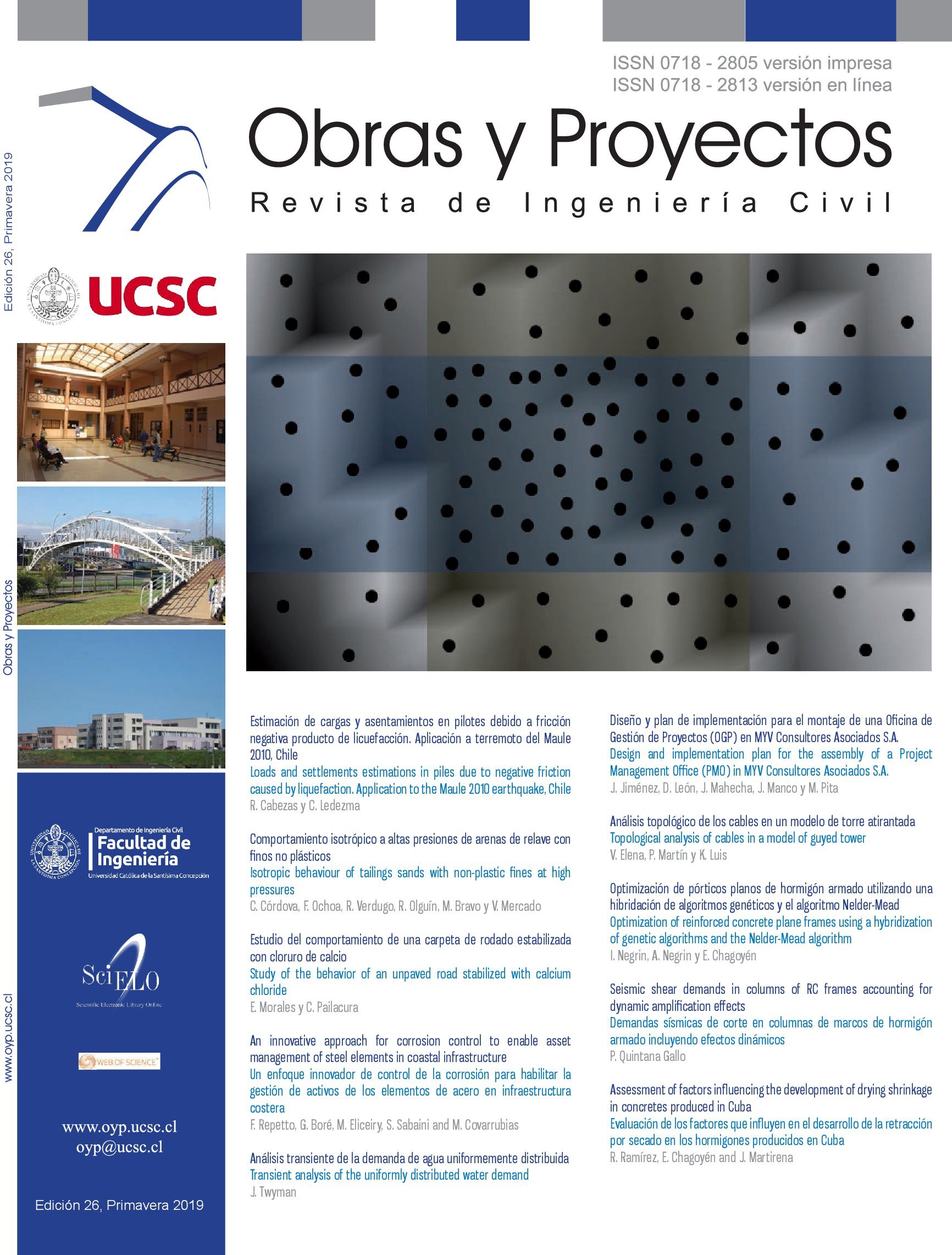
Transient analysis of the uniformly distributed water demand
DOI:
https://doi.org/10.4067/S0718-28132019000200043Keywords:
Water hammer, Method of characteristics MOC, Uniformly distributed demand UDDAbstract
Transient flow generated in pipe networks by uniformly distributed demands (UDDs) is analyzed. An original numerical algorithm based on the Method of Characteristics (MOC) is shown, which allows including the pressure−insensitive UDD’s approach at the pipe internal nodes without modifying its original discretization. The results delivered by the UDD’s approach are compared with the approach that distributes 50% of the total water demand in the pipe’s upstream and downstream ends. The general conclusion is that the UDD’s approach is useful to know the pipe transient behaviour when every one of its internal nodes have a water demand, although its formulation is preliminary and it requires some extensions that allow it to approach the problem in more suitable way.
References
Chaudhry, M.H. (2014). Transient-flow equations. In Applied Hydraulic Transients. Springer, New York, USA, 35-64.
Chaudhry, M.H. (1979). Applied hydraulic transients. Van Nostrand Reinhold, New York, USA.
Chaudhry, M.H. (1968). Boundary conditions for analysis of waterhammer in pipe systems. Thesis of Applied Science, The University of British Columbia, Canada.
Filion, Y., Adams, B. and Karney, B. (2007). Cross correlation of demands in water distribution network design. Journal of Water Resources Planning and Management 133(2), 137-144.
Gad, A.A. and Mohammed, H.I. (2014). Impact of pipe network simplification on water hammer phenomenon. Sadhana 39(5), 1227-1244.
Ghidaoui, M.S., Zhao, M., McInnis, D.A. and Axworthy, D.H. (2005). A review of water hammer theory and practice. Applied Mechanics Reviews 58, 49-76.
Izquierdo, J., Campbell, E., Montalvo, I., Pérez-García, R. and Ayala-Cabrera, D. (2013). Error analysis of some demand simplifications in hydraulic models of water supply networks. Abstract and Applied Analysis 2013, article ID 169670, 1-13.
Jung, B.S., Boulos, P.F. and Wood, D.J. (2009). Effect of pressure-sensitive demand on surge analysis. Journal of the American Water Works Association 101(4), 100-111.
Jung, B.S., Boulos, P.F. and Wood, D.J. (2007). Pitfalls of water distribution model skeletonization for surge analysis. Journal of the American Water Works Association 99(12), 87-98.
Kanakoudis, V. and Gonelas, K. (2015). Accurate water demand spatial allocation for water networks modelling using a new approach. Urban Water Journal 12(5), 362-379.
Karney, B.W. (1984). Analysis of fluid transients in large distribution networks. PhD thesis, University of British Columbia, Vancouver, Canada.
Karney B.W and McInnis D. (1992). Efficient calculation of transient flow in simple pipe networks. Journal of Hydraulic Engineering 118(7), 1014-1030.
McInnis, D. and Karney, B.W. (1995). Transients in distribution networks: field tests and demand models. Journal of Hydraulic Engineering 121(3), 218-231.
Mohammed, H.I. and Gad, A.A. (2012). Effect of pipe network simplification on water hammer phenomenon. Journal of Engineering Sciences 40(6), 1625-1647.
Rao, R.M., Ahmed, Z., Ellamraj, Y. and Reddy, R.M. (2015). EPAnet demand calculation methods and implications. International Journal of Scientific Engineering and Research (IJSER) 4(11), 73-76.
Salgado, R., Rojo, J. and Zepeda, S. (1994). Extended gradient method for fully non-linear head and flow analysis in pipe networks. Integrated Computer Applications in Water Supply, Methods and Procedures for Systems Simulation and Control. B. Coulbeck (ed.), John Wiley & Sons, Inc. NY, USA. vol. 1, 49-60.
Salgado, R., Twyman, C. and Twyman, J. (1992). Development of a hybrid algorithm for fast transient analysis in pipe networks. XV Congreso Latinoamericano de Hidráulica IAHR, 483-493.
Shamrukh, M. (2005). Applicability of using the multiple lateral demands for designing water networks. First Ain Shams University International Conference on Environmental Engineering, Cairo, Egypt, 562-572.
Tsakiris, G. and Spiliotis, M. (2012). Applying resilience indices for assessing the reliability of water distribution systems. Water Utility Journal 3, 19-27.
Twyman, J. (2018). Transient flow analysis using the method of characteristics MOC with five-point interpolation scheme. Obras y Proyectos 24, 62-70.
Twyman, J. (2017). Water hammer analysis in a water distribution system. Ingeniería del Agua 21(2), 87-102.
Twyman, J. (2016a). Golpe de ariete en una red de distribución de agua. XXVII Congreso Latinoamericano de Hidráulica IAHR Spain Water and IWHR China, Lima, Perú.
Twyman, J. (2016b). Wave speed calculation for water hammer analysis. Obras y Proyectos 20, 86-92.
Watters, G.Z. (1984). Analysis and control of unsteady flow in pipelines. Butterworth, 2nd edition, Boston, USA.
Watters G.Z. (1979). Modern analysis and control of unsteady flow in pipelines. Ann Arbor Science. Michigan, USA.
Wu, Z.Y. and Walski, T. (2006). Pressure dependent hydraulic modelling for water distribution systems under abnormal conditions. IWA World Water Congress and Exhibition, Beijing, China.
Wylie, B. (1986). Liquid transient flow in piping systems. In Advancements in Aerodynamics, Fluid Mechanics and Hydraulics, ASCE, Arndt, R.E., Stefan, H.G., Farell, C. and Peterson, S.M. (eds.), 50-57.
Wylie, B. and Streeter, V.L. (1993). Fluid transients in systems. Pearson. 1st. Edition.
Wylie, B. and Streeter, V.L. (1978). Fluid transients. McGrawHill, International Book Company.
Downloads
Published
Issue
Section
License

This work is licensed under a Creative Commons Attribution-NonCommercial 4.0 International License.