Metodos de selección y escalamiento de registros sísmicos para análisis de la respuesta en el tiempo
DOI:
https://doi.org/10.21703/0718-2813.2009.5.3679Palabras clave:
norma sísmica, analisis de la respuesta en el tiempo, selección de registros, escalamiento de registros, terremotos de ChileResumen
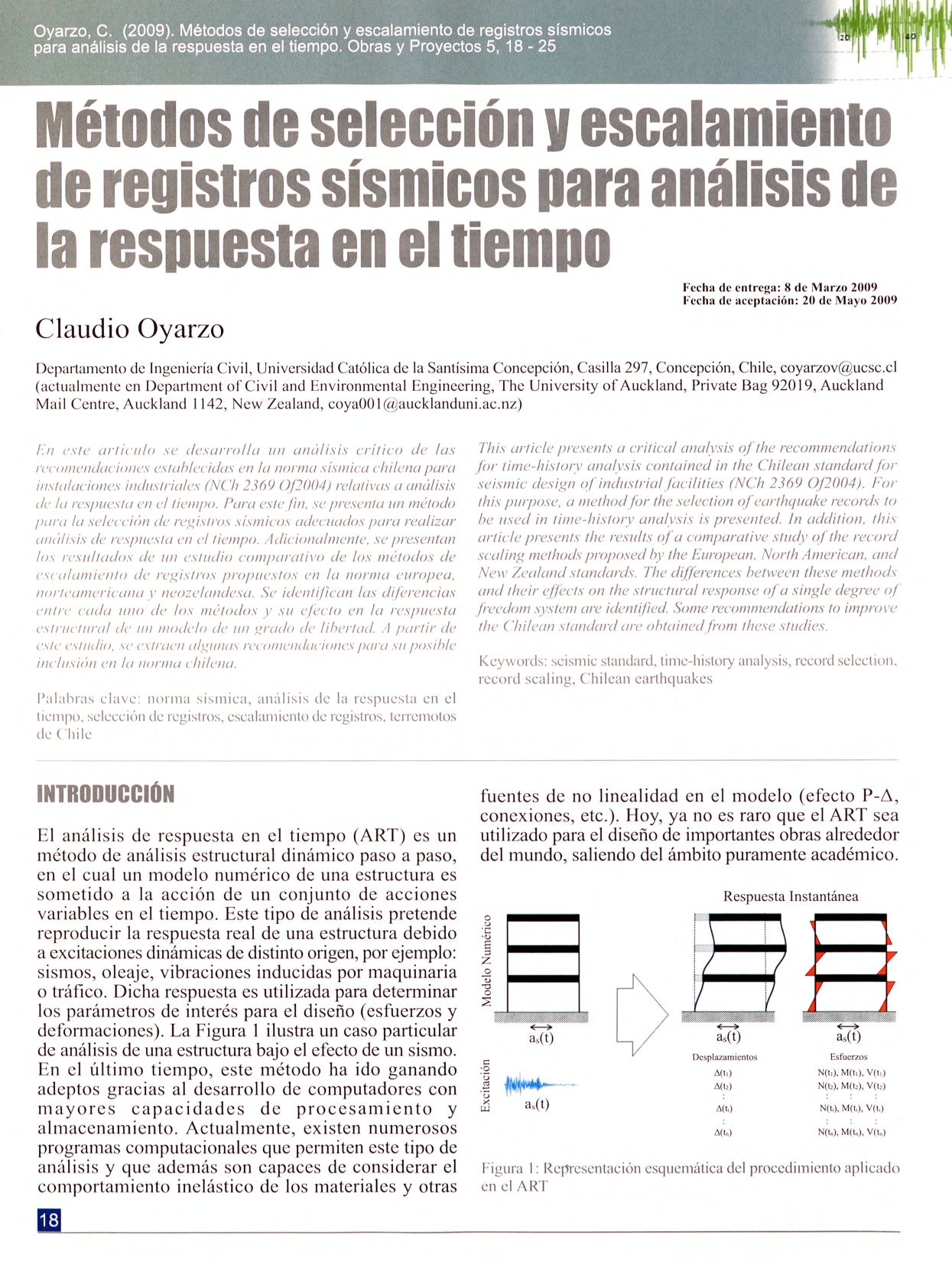
En este artículo se desarrolla un análisis crítico de las recomendaciones establecidas en la norma sísmica chilena para instalaciones industriales (NCh 2369 Of2004) relativas a análisis de la respuesta en el tiempo. Para este fin, se presenta un método para la selección de registros sismicos adecuados para realizar andlisis de respuesta en el tiempo. Adicionalmente, se presentan los resultados de un estudio comparativo de los métodos de escalamiento de registros propuestos en la norma europea, norteamericana y neozelandesa. Se identifican las diferencias entre cada uno de los métodos y su efecto en la respuesta estructural de un modelo de un grado de libertad. A partir de este estudio, se extraen algunas recomendaciones para su posible inclusion en la norma chilena.
Referencias
ASCE (2007). ASCE 41-06. Seismic rehabilitation of existing buildings. American Society of Civil Engineers, Reston, Va., xvi, 410.
Baker,J. and Cornell,A. (2006). Spectral shape, epsilon and record selection. Earthquake Engineering and Structural Dynamics 35, 1077-1095 DOI: https://doi.org/10.1002/eqe.571
Bommer, J. J. and Acevedo, A. B. (2004). The use of real earthquake accelerograms as input to dynamic analysis. Journal of Earthquake Engineering 8, 43-91 Carr, A. J. (2004). Ruaumoko —Aprogram for inelastic time-history analysis. Department of Civil Engineering, University of DOI: https://doi.org/10.1080/13632460409350521
Canterbury, New Zcaland
Comartin, C., Niewiaroski, R. and Rojahn, C. (1996). ATC-40 Seismic evaluation and retrofit of conerete buildings. SSC 96-01, Aplied Technology Council, CA, USA
Comell, C. (2005). On earthquake record selection for nonlinear dynamic analysis. The Esteva Symposium, Mexico, August 2005
COSMOS (1999). COSMOS VirtualData Center. http://db.cosmos- eq.org/scripts/default.plx (01.May.2009)
Dhakal, R., Singh, S. and Mander, J. (2007). Effectiveness of earthquake selection and scaling procedure method in New DOI: https://doi.org/10.5459/bnzsee.40.3.160-171
Zealand. Bulletin of the New Zealand Society for Earthquake Engineering 40(3), 160-171
ECS (2004). Eurocode 8: Design of structures for earthquake resistance - Part 1: General rules, seismic actions and rules for buildings. Europcan Committec for Standardization, Brussels, Belgium
EQC New Zealand and GNS Science. (2004). GeoNet Strong Motion Data. ftp://ftp.gconct.org.nz/strong/processed (01.May.2009)
Iervolino, 1. and Cornell, A. (2005). Record selection for nonlinear seismic analysis of structures. Earthquake Spectra 21(3), 685- 713 DOI: https://doi.org/10.1193/1.1990199
INN Chile. (2003). Diseño sismico de estructuras e instalaciones industrial NCh 2369 Of 2003." Instituto Nacional de Normalización, Santiago, Chile
Otani, S. (1981). Hysteresis models of reinforced concrete for earthquake response analysis. Journal of Faculty of Engineering, University of Tokyo 36(2), 407-441
Oyarzo-Vera, C., Fleming, R., McVerry,G. and Ingham,J. (2009). Seismic zonation and default suite of ground motion records for time-history analysis in New Zealand. New Zealand Society of Earthquake Engineering Conference, Christchurch, New Zealand, 3-5 April 2009
Oyarzo-Vera,C. and Chouw,N. (2008). Comparison of record scaling methods proposed by standards currently applied in different countrics. /41h World Conference on Earthquake Engineering, Beijing, China, 12-17 October 2008
PEER Center. (2005). PE http://peer.berkeley.cdu/nga/index.html :R NGA Data basc (01.May.2009)
SNZ (2004). NZS 1170.5:2004 - Structural design actions. Earthquake actions. Standards New Zcaland, Wellington, New Zealand
Somerville, P. G., Smith, N. F., Graves, R. W. and Abrahamson, N. A. (1997). Modification of empirical strong ground motion attenuation relations to include the amplitude and duration effects of rupture directivity. Seismological Research Letters 68(1), 199- 222 DOI: https://doi.org/10.1785/gssrl.68.1.199
Stirling, M., McVerry, G. and Berryman, K. (2002). A new seismic hazard model for New Zealand. Bulletin of the Seismological Society of America 92(5), 1878-1903 DOI: https://doi.org/10.1785/0120010156
Descargas
Publicado
Número
Sección
Licencia
Derechos de autor 2009 Universidad Católica de la Santísima Concepción

Esta obra está bajo una licencia internacional Creative Commons Atribución-NoComercial 4.0.