Diseño, construcción, operación y el efecto del contenido de finos y la permeabilidad en el desempeño sísmico de presas de relave de arena en Chile
DOI:
https://doi.org/10.4067/S0718-28132016000100001Palabras clave:
Presas de relaves, Presas de tierra, Fallas de presas, MineríaResumen
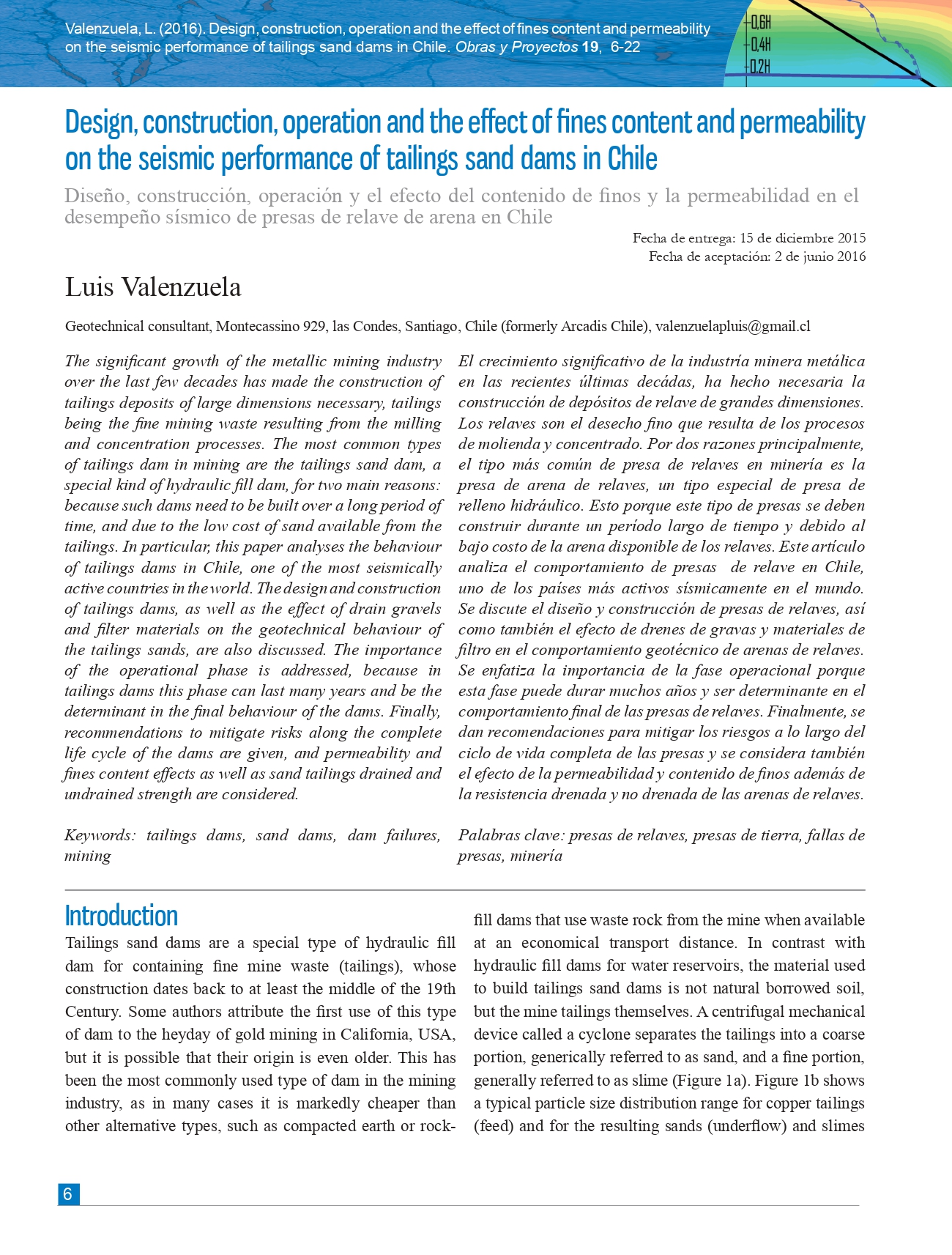
El crecimiento significativo de la industría minera metálica en las recientes últimas decádas, ha hecho necesaria la construcción de depósitos de relave de grandes dimensiones. Los relaves son el desecho fino que resulta de los procesos de molienda y concentrado. Por dos razones principalmente, el tipo más común de presa de relaves en minería es la presa de arena de relaves, un tipo especial de presa de relleno hidráulico. Esto porque este tipo de presas se deben construir durante un período largo de tiempo y debido al bajo costo de la arena disponible de los relaves. Este artículo analiza el comportamiento de presas de relave en Chile, uno de los países más activos sísmicamente en el mundo. Se discute el diseño y construcción de presas de relaves, así como también el efecto de drenes de gravas y materiales de filtro en el comportamiento geotécnico de arenas de relaves. Se enfatiza la importancia de la fase operacional porque esta fase puede durar muchos años y ser determinante en el comportamiento final de las presas de relaves. Finalmente, se dan recomendaciones para mitigar los riesgos a lo largo del ciclo de vida completa de las presas y se considera también el efecto de la permeabilidad y contenido de finos además de la resistencia drenada y no drenada de las arenas de relaves.
Referencias
Agüero, G. (1929). Formación de depósitos de relaves en el mineral de El Teniente. Anales del Instituto de Ingenieros de Chile 5, 164-187.
Bard, E. Campaña, J. Torres, P. Valenzuela, L. y Cifuentes, L. (2014). Comportamiento de arenas a altas presiones de confinamiento: comparación entre arenas de relaves y naturales. VIII Congreso Chileno de Geotecnia, Santiago.
Blight, G.E. (2010). Geotechnical engineering for mine waste storage facilities. Taylor & Francis.
Campaña, J. Carmi, C. Bard, E. and Valenzuela, L. (2015). Permeability and consolidation parameters in tailings treated with seawater. XV Pan-American Conference on Soil Mechanics and Geotechnical Engineering, Buenos Aires.
Campaña, J., Bard, E. and Verdugo, R. (2013). Shear strength and deformation modulus of tailing sands under high pressures. Proceedings of the 18th Conference on Soil Mechanics and Geotechnical Engineering, Paris.
Campaña, J. (2011). Comportamiento de arenas de relave a altas presiones. Tesis MSc, Universidad de Chile.
Castro, G. and Troncoso, J.H. (1989). Seismic behavior of three tailings dams during the March 3, 1985 Earthquake. 5th Chilean Conference on Seismology and Earthquake Engineering, Santiago.
Cochilco (2014). Anuario de Estadísticas del Cobre y otros Minerales 1994 – 2013. Comisión Chilena del Cobre.
Conlin, B. (1987). A review of the performance of mine tailings impoundments under earthquake loading conditions. Proceedings of the Vancouver Geotechnical Society Seminar on Earthquake.
Davies, M.P. Martin, T.E. and Lighthall, P. (2000). Mine tailings dams: when things go wrong. Tailings Dams 2000, Association of State Dam Safety Officials, U.S. Committee on Large Dams, 261-273.
Dobry, R. and Alvarez, L. (1967). Seismic failure of Chilean tailings dams. Journal of the Soil Mechanics and Foundations Division 93(6), 237-259.
Figueroa, A., Valenzuela, L., Sconagmillo, C., Santos, E. and Tascón, A. (2015). Particle – size segregation in sand tailings dams. XV Pan-American Conference on Soil Mechanics and Geotechnical Engineering, Buenos Aires.
Finn, W. D. L. (1996). Seismic design and evaluation of tailings dams: state of the art. Proceedings International Symposium on Seismic and Environmental Aspects of Dams Design: Earth, Concrete and Tailings Dams, ICOLD – ISSMFE, Chilean Geotechnical Society, 7-34.
ICOLD (2001). Tailings dams − risk of dangerous occurrences. Bulletin 121.
ICOLD (1995). Dam failure statistical analysis. Bulletin 99.
Illanes, J., Urquidi, J., Figueroa, A., Campaña, J. and Morales, F. (2015). Geotechnical instrumentation in tailings sand dams. XV Pan-American Conference on Soil Mechanics and Geotechnical Engineering, Buenos Aires.
Ishihara, K. (1984). Post-earthquake failure of a tailings dam due to liquefaction of the pond deposit. Proceedings of the International Conference on Case Histories in Geotechnical Engineering, St. Louis, Missouri, 3, 1129-1143.
Ishihara, K. (1993). Liquefaction and flow failure during earthquakes. Géotechnique 43(3), 351-451.
Ishihara, K. Ueno, K. Yamada, S. Yasuda, S. and Yoneoka, T. (2015). Breach of a tailings dam in the 2011 earthquake in Japan. Soil Dynamics and Earthquake Engineering 68, 3-22.
Lee, K.L. and Seed, H. (1967). Drained strength characteristics of sands. Journal of Soil Mechanics and Foundation Division 93(6), 117-141.
Lo, R.C. Klohn, E.J. and Finn, W.D.L. (1988). Stability of hydraulic sandfill tailings dams. In Hydraulic Fill Structures, ASCE Geotech. 21, 549-572.
Martin, T.E, Davies, M.P., Rice, S., Higgs, T. and Lighthall, P.C. (2002). Stewardship of tailings facilities. Mining, Minerals and Sustainable Development No. 20. International Institute for Environment and Development.
Miura, N. and Yamanouchi, T. (1975). Effect of water on the behavior of quartz-rich sand under high stresses. Soils and Foundations 15(4), 23-34.
MM (2007). Decreto Supremo Nº 248. Reglamento para la aprobación de proyectos de diseño, construcción, operación y cierre de los depósitos de relaves. Ministerio de Minería de Chile.
MM (1970). Decreto Supremo Nº 86. Reglamento de construcción y operación de tranques de relaves. Ministerio de Minería de Chile.
Murthy, T. Loukidis, D. Carrasco, J. Prezzi, M. and Salgado, R. (2007). Undrained monotic response of clean and silty sands. Géotechnique 57(3), 273-288.
Obermeyer, J. and Alexieva, T. (2011). Design, construction and operation of a large centerline tailings storage facility with high rate of rise. Proc. Tailings and Mine Waste, Vancouver.
Peck, R.B. (1980). Where has all the judgement gone?. The 5th Laurits Bjerrum Memorial Lecture. Canadian Geotechnical Journal 17(4), 584-590.
Priscu, C. (2014). Seguridad de presas y geotecnia – Áreas interrelacionadas. Presentation at the VIII Congreso Chileno de Ingeniería Geotécnica, Santiago.
Ramirez, N. (2010). Effects of the 2010 earthquake on tailings disposals located on the South-Central Chile and its relation with Decreto 248. Seminar: Proposals for the operation of tailings disposals according to recent experiences, 2010 (in Spanish).
Scott, M.D., Lo, R.C. and Thavaraj, T. (2007). Use of instrumentation to safeguard of tailings dams. 7th International Symposium on Field Measurements in Geomechanics, ASCE, 1-13.
Swaisgood, J. (2002). Investigation and evaluation of Quillayes dam. High Density and Past Seminar, Santiago, Chile.
Troncoso, J.H. (2015). Personal communication to L. Valenzuela, June 2015.
Troncoso, J.H. (2014). Seismic design of tailings dams – State of practice in South America. In Workshop of Seismic Design of Tailings Dams, 34th USSD Annual Meeting and Conference, San Francisco.
Troncoso, J.H., Avendaño, A. and Vergara, A. (1993). The seismic failure of Barahona tailings dam. 3rd International Conference on Case Histories in Geotechnical Engineering, 1473-1479.
USCOLD (1994). Tailings dams incidents. USCOLD Committee on Tailings Dams.
Valenzuela, L. (2015). Tailings dams and hydraulic fills. Casagrande Lecture, XV Panamerican Conference on Soil Mechanics and Geotechnical Engineering, Buenos Aires.
Valenzuela, L. (2010). Chile earthquake and its impact on infrastructure. Congresso Brasileiro de Mecánica dos Solos e Engenharia Geotecnica, Brasil.
Valenzuela, L. (1996). Main characteristics of large tailings dams. In Large Dams in Chile, ICOLD Chile annual meeting of ICOLD International, Santiago.
Valenzuela, L. and Campaña, J. (2014). Sand tailings dams in Chile and its evolution since 1965. 2nd International Seminar on Tailings Management, Antofagasta, Chile.
Valenzuela, L., Alemparte, R. and Nicolau, R. (2013). Outsourcing of tailings operations: a successful case. 1st International Seminar on Tailings Management, Santiago, Chile.
Valenzuela, L. and Barrera, S. (2003). Seismic design of Los Quillayes tailings dams in Chile. XII Panamerican Conference on Soil Mechanics and Geotechnical Engineering, Cambridge, USA.
Verdugo, R. (2011). Seismic stability analysis of large tailings dams. Proceedings 5th International Conference on Earthquake Geotechnical Engineering, Santiago, 359-383.
Verdugo, R. (1992). Characterization of sandy soil behavior under large deformation. PhD thesis, University of Tokyo.
Vick, S.G., Dorey, R., Finn, W.D.L. and Adams, R.C. (1993). Seismic stabilization of St. Joe State Park tailings dams. In Geotechnical Practice in Dam Rehabilitation, ASCE, 402-415.
Vick, S.G. (1983). Planning, design and analysis of tailings dams. John Wiley & Sons.
Villavicencio, G. Espinace, R. Palma, J. Fourie, A. and Valenzuela, P. (2014). Failure of sand tailings dams in a highly seismic country. Canadian Geotechnical Journal 51(4), 449-464.
Wei, Z., Yin, G., Wang, J.G., Wan, L. and Li, G. (2013). Design, construction and management of tailings storage facilities for surface disposal in China: case studies of failures. Waste Management & Research 31(11), 106-112.
Xin, H., Finn, W. and Wang, Y. (1992). Lessons from seismic performances of Chinese tailings dams. Report of Department of Civil Engineering, University of British Columbia, Canada.
Descargas
Publicado
Número
Sección
Licencia
Derechos de autor 2016 Universidad Católica de la Santísima Concepción

Esta obra está bajo una licencia internacional Creative Commons Atribución-NoComercial 4.0.